

Guide to Block-on-Ring Friction Wear Equipment

Working Principle of Block-on-Ring Test Machine
This Block-on-Ring Test Machine adopts a friction pair consisting of a stationary block specimen and a rotating ring specimen to realize linear-contact sliding friction. A servo or lever structure applies stable normal load, while the main spindle drives the ring to rotate at a constant speed to generate controllable relative sliding motion.
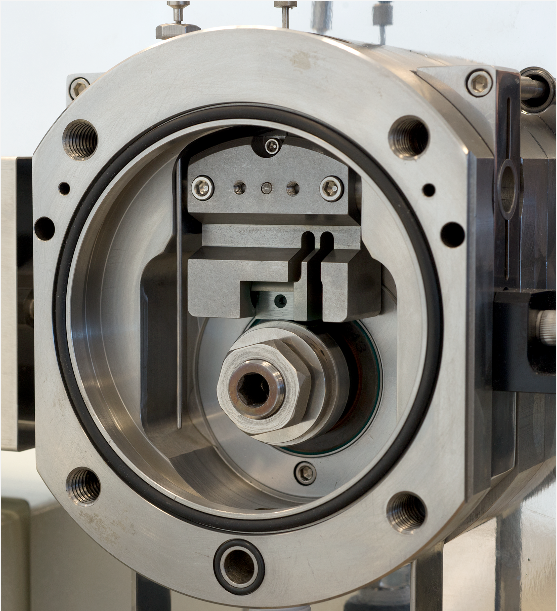
A friction force sensor collects tangential resistance in real time, and the system calculates the friction coefficient synchronously. After the test, the wear rate and wear resistance of samples are quantified by measuring wear scar width, mass loss or wear volume. It accurately simulates linear contact service conditions of shaft sleeves, gears, guide rails and other mechanical components.
Structure of Block-on-Ring Test Machine
Main Frame: Integrated welded base with high rigidity and anti-vibration performance.
Spindle Driving System: Servo or variable frequency motor with synchronous belt transmission for stepless speed regulation and closed-loop speed control.
Loading System: Closed-loop motor or weight lever loading, equipped with real-time calibrated force sensors to ensure stable load without drift.
Friction Pair Assembly: Standard ring specimens (Φ49.22×13.06 mm) and block specimens (12.32×19.05 mm), easy to install and align.
Lubrication & Temperature Control System: Sealed oil chamber and circulating oil circuit with heating/cooling functions to reproduce oil immersion and boundary lubrication environments.
Signal Acquisition System: Multi-channel synchronous collection of normal force, friction force, rotational speed and temperature signals.
Electric Control & Analysis Software: PLC and industrial computer for parameter setting, real-time curve plotting, data export and automatic stop.
Application Fields of Block-on-Ring Test Machine
Lubricant Industry: Evaluate extreme pressure, anti-wear and load-bearing performance of gear oil, hydraulic oil and lubricating grease.
Material R&D: Compare sliding wear properties of metals, engineering plastics, composite materials and surface coatings.
Automotive Components: Simulate working conditions and predict service life of shaft sleeves, gears, piston rings and bearings.
Quality Inspection & Scientific Research: Factory quality control of raw materials, tribology mechanism research and lubricant formula optimization verification.
Mechanical Equipment Industry: Wear reliability testing of guide rails, sealing parts and transmission components.
Compliant Standards for Block-on-Ring Test Machine
Chinese National Standard: GB/T 12444-2006 Metallic materials — Test method for sliding wear with ring and block specimens
ASTM International Standards: ASTM G77, ASTM D2714 (Falex block-on-ring test), ASTM G137 (for plastics)
Petroleum Industry Standard: SH/T 0202, SH/T 0204 (extreme pressure and anti-wear test of lubricating greases)
5. Market Price of Block-on-Ring Test Machine (2026, Tax Not Included)
Basic model (room temperature, lever loading): RMB 50,000 – 100,000, for routine material and lubricant testing.
Standard model (servo loading, temperature-controlled oil bath): RMB 100,000 – 300,000, mainstream configuration for enterprise QC labs and university research labs.
High-speed high-temperature model (max speed ≥ 3000 r/min, temperature up to 200℃): RMB 300,000 – 600,000, for advanced tribology research.
Imported Falex / Timken equipment: RMB 800,000 – 2,000,000, featuring ultra-high precision and long-term stability.
Lubrication Mechanism of Block-on-Ring Test Machine
Lubricating oil or grease forms protective lubricating films between ring and block specimens via oil immersion or drip feeding to separate friction pairs. Three typical lubrication states can be reproduced:
Fluid Lubrication: A hydrodynamic oil film forms under high rotating speed, leading to low friction coefficient and negligible wear.
Mixed Lubrication: Partial asperity contact occurs under medium load and speed, balancing friction reduction and load capacity.
Boundary Lubrication: Under heavy load and low speed, anti-wear performance depends on adsorption film or chemical reaction film formed by lubricant additives.
By adjusting temperature and rotational speed, the tester reproduces actual lubrication conditions to assess the anti-friction, anti-wear and extreme pressure capacity of lubricants.
Standard Operating Procedures for Block-on-Ring Test Machine
Specimen Pretreatment: Clean ring and block samples with ethanol ultrasonic bath for 10–15 minutes and fully dry to remove oil stains and burrs.
Startup & Calibration: Power on and preheat the machine; perform zero calibration for force sensors and full-range calibration with standard weights.
Specimen Mounting & Alignment: Install ring and block correctly to ensure complete linear contact without eccentric load.
Lubricant Filling & Parameter Setup: Add target lubricant into the oil chamber; set test parameters including load, rotating speed, temperature and test duration on software.
No-load Trial Run: Check spindle rotation, oil circulation and sensor signal stability.
Formal Test: Apply load smoothly and start the spindle; monitor real-time friction coefficient curves during operation.
Termination & Unloading: The machine stops automatically when time expires. Unload the force first and cool down to ambient temperature before disassembling specimens.
Post-test Treatment & Data Export: Clean tested samples, measure wear scar or record mass loss; export test curves and generate standardized test reports via software.
Guidelines for Selecting Block-on-Ring Test Machine
Standard Compatibility: Prioritize equipment fully compliant with GB/T 12444, ASTM D2714 and ASTM G77.
Load & Precision Requirements: Conventional load range 500–5000 N, force error ≤ ±1% and resolution ≥ 0.1 N for regular testing.
Rotational Speed Range: Standard range 100–3000 r/min; choose closed-loop servo driving if high-speed testing is required.
Lubrication & Temperature Control: Oil bath heating system (ambient ~ 150℃) is mandatory for lubricant evaluation.
Traceable Data System: Software shall support export of original data, friction curves and audit-ready reports, compatible with third-party metrology calibration.
After-sales Support: Select manufacturers offering on-site calibration, spare parts supply and professional technical training.
Cost Control: Domestic standard models (RMB 100,000–300,000) deliver optimal cost performance for most quality inspection and research scenarios.
Summary
The block-on-ring test machine is standardized core tribology equipment for linear contact sliding friction and wear tests. With stationary block and rotating ring specimens, it accurately simulates real service conditions of transmission mechanical parts and quantitatively measures friction coefficient and wear rate to evaluate the tribological performance of materials and lubricants.
The product fully meets domestic and international test standards, with market prices ranging from RMB 50,000 to 2 million. When purchasing, users shall take standard compliance, load precision and temperature-lubrication module as core selection indicators. Domestic models can satisfy most routine R&D and quality inspection demands. Standardized operation and regular metrology calibration are essential to guarantee reliable test data and extend equipment service life.
2026-07-09 11:31
- Related News
How to Choose a Suitable Drying Rate Tester?
What Is a Fabric ICI Pilling and Snagging Box?
How to Choose an ICI Mace Snag Tester?
What a Fiber Oil Extractor Actually Does?
Snap Button Pull Tester: Garment Accessory Tensile Strength Testing Guide
Guide to Block-on-Ring Friction Wear Equipment
How to Choose Universal Multifunction Tribology Test Machine
How to Choose an Air-Cooled Xenon Lamp Aging Chamber
What Does an Ozone Aging Chamber Test? Standards and Operating Methods
Fabric Cool Feeling Tester: Working Principle, Standards and Selection Guide