

Compression Hosiery Tester Technical Guide

This professional guide is compiled in strict accordance with domestic textile and medical device standards as well as international European & German testing norms, It serves R&D engineers, laboratory inspectors, production QC personnel and equipment procurement managers for medical compression stockings, sports compression socks and graduated compression hosiery.
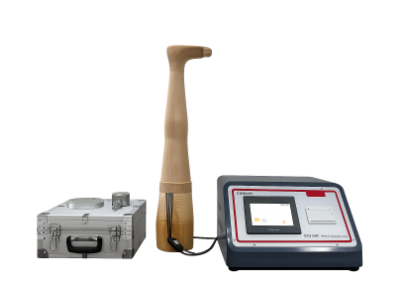
1. Functions of Compression Hosiery Tester
The compression hosiery tester is a dedicated precision testing instrument for measuring the contact compression pressure, pressure gradient and pressure durability of medical anti-thrombosis stockings, varicose vein compression socks, sports compression hosiery and elastic leg sleeves. Its core functional modules are as follows:
Multi-point synchronous static pressure testing
Equipped with standard segmented rigid leg mould fitted with 7 independent pressure sensing points covering ankle, calf, below-knee and thigh key positions; it synchronously collects real-time contact pressure values and generates full-length longitudinal pressure distribution curves.
Two core test modes
Static mode: Test initial fitted compression, transverse pressure uniformity and standard graded pressure gradient; automatically judge whether products meet medical compression grade requirements.
Dynamic fatigue mode: Simulate long-term daily wear via thousands of cyclic stretching loads, calculate pressure retention rate and pressure attenuation percentage after fatigue cycles.
Intelligent data analysis & report output
Built-in standard calculation formulas, automatically compute pressure difference between adjacent measuring points, residual pressure and elastic hysteresis loss; visualize data via line charts and radar graphs, support one-click export of PDF/CSV test reports with customizable laboratory templates.
Multi-unit switching & calibration management
Freely switch pressure units between mmHg and kPa; support automatic zero drift compensation, regular calibration records storage and traceable calibration data for CNAS/CMA accredited labs.
Wide sample compatibility
Match standard leg moulds of Chinese S/M/L sizes and European S/M/L/XL sizes, compatible with below-knee, thigh-length and pantyhose compression products made of polyester, cotton blended and spandex elastic fabrics.
This instrument is mandatory quality inspection equipment for compression hosiery production batch control, medical device registration testing and third-party textile laboratory verification.
2. Working Principle of Compression Hosiery Tester
Two mainstream mature technical structures are adopted in the industry, both calibrated against standard pressure weights to convert elastic fabric tension into contact pressure values via Laplace elastic mechanics formula:
2.1 Thin Film Pressure Sensing Principle (Most Widely Used)
Flexible thin-film pressure sensor arrays are attached to the surface of a rigid standard leg mould. When compression hosiery is evenly sleeved on the mould, the elastic retraction force of the fabric uniformly squeezes the film sensor. The film produces resistance deformation under compression, and the acquisition host converts resistance variation into electrical signals. After multi-point standard calibration, the system accurately outputs contact pressure values in mmHg.
2.2 Airbag Pressure Detection Principle
Segmented closed air chambers are distributed on the leg mould surface. The elastic pressure of the hosiery compresses airbags and changes internal air pressure; the pressure sensor captures air pressure increment to calculate the actual contact compression between the stocking and human leg.
Core Calculation Logic
Based on the Laplace formula for fabric circumferential tension:
P=R2T
Where:
P= contact compression pressure;
T= circumferential elastic tension of fabric;
R= radius of the leg mould at the measuring point.
The system automatically calibrates mould radius parameters and eliminates system constant errors to ensure repeatable and accurate test results.
3. Is Compression Hosiery Testing Time-Consuming?
Test duration varies by test mode and sample type, fully compliant with standard testing operation cycles:
Static graded pressure test (routine QC inspection): 10–20 minutes per sample, including sample conditioning, sleeving placement and steady-state data collection;
Dynamic fatigue pressure attenuation test (durability evaluation): Settable cycle counts from 100 to 10,000 cycles; 1000 cycles take 30–45 minutes, while full 10,000-cycle fatigue testing takes 4–6 hours with unattended automatic operation;
Instrument calibration & blank verification: 5–10 minutes for zero calibration and standard reference sample verification.
The tester supports automatic steady-state judgment, stops data collection once pressure fluctuation stabilizes, and requires no continuous manual monitoring during the whole test process.
4. Applicable Standards for Compression Hosiery Tester
The qualified equipment natively supports domestic textile, medical device and international European compression textile standards, with pre-built standard parameter templates:
Domestic Standards
FZ/T 73031-2009 Compression Hosiery (textile industry standard for civilian compression socks)
YY/T 0851-2023 Medical Anti-Thrombosis Stockings
YY/T 0853-2024 Medical Varicose Vein Compression Stockings
International & European Standards
CEN/TR 15831 Test Methods for Compression Performance of Medical Hosiery
RAL-GZ 387/1 Standard for Medical Compression Textiles – Part 1: Pressure Measurement & Compression Grade Classification
DD ENV 12718 Medical Compression Knitted Fabrics Test Specification
ISO 13994 Medical Compression Garments Performance Evaluation
All standard grading thresholds (Class I / II / III medical compression grades) are pre-stored in the software for automatic pass/fail judgment.
5. Standard Test Procedures for Compression Hosiery
Step 1 Sample Pre-Conditioning
Place samples under standard atmospheric environment: (20±2) ℃, (65±4) %RH for no less than 24 hours to balance moisture content; eliminate fiber internal stress and moisture interference to elastic tension.
Step 2 Instrument Preparation
Power on and preheat the tester for 10 minutes; perform automatic zero calibration of pressure sensors; select the matching standard leg mould according to sample size.
Step 3 Sample Mounting
Smoothly sleeve the compression hosiery onto the leg mould without twisting, stretching or wrinkling; align the sample marking lines with the standard measuring points on the mould surface to avoid artificial pressure deviation.
Step 4 Static Pressure Testing
Start static acquisition; the system collects pressure data at all 7 points in real time until pressure fluctuation is within the standard stable threshold; automatically record pressure values and gradient differences.
Step 5 Optional Dynamic Fatigue Test
Set target cycle counts, start cyclic stretching loading; after completing cycles, re-test static pressure to calculate pressure retention rate and attenuation rate.
Step 6 Data Export & Report Generation
Save raw pressure curves and numerical data; export standardized test reports with sample information, standard number, test date and automatic grade judgment results.
6. Influencing Factors of Compression Pressure Test Results
6.1 Material & Fabric Structure Factors
Spandex fiber content and elastic recovery rate: Higher spandex proportion brings larger initial compression pressure; poor elastic recovery leads to severe pressure attenuation after wear;
Fabric density, weave structure and seam position: Stitched cuffs and ankle seams form local high-pressure points; loose knitted fabrics deliver lower overall compression;
Sample moisture content: Unconditioned damp samples reduce fabric elastic tension and cause lower test pressure readings.
6.2 Testing Operation Factors
Sample sleeving state: Over-stretching or twisting during mounting will artificially raise pressure values; wrinkles cause uneven local pressure;
Measuring point alignment offset: Misalignment between sample marking and mould sensor leads to gradient calculation errors;
Leg mould size mismatch: Using an oversized/smaller mould against the sample nominal size changes fabric stretch ratio and distorts compression data.
6.3 Instrument & Environmental Factors
Sensor drift without regular calibration; damaged thin-film sensors cause unstable pressure signals;
Laboratory temperature fluctuation: High temperature softens spandex fibers and reduces fabric elastic tension;
Vibration and airflow interference during testing break pressure steady state.
7. Key Test Precautions for Compression Hosiery
Complete sample conditioning is mandatory; unbalanced samples may generate data deviation exceeding 12%;
Do not forcibly stretch the hosiery when sleeving onto the leg mould; keep the fabric in its natural fitted state consistent with actual human wear;
Verify sensor zero drift before each batch of testing; conduct full machine calibration every 12 months with standard pressure calibration weights;
Avoid touching and scratching the thin-film pressure sensors; clean the mould surface with soft cloth after each test to remove fabric fiber debris;
Do not open the test station or adjust the sample position during steady-state data collection; restart testing if the sample slips;
Select the corresponding standard leg mould by sample size; cross-size mould use invalidates all comparison data;
For multi-layer composite compression stockings, test in the actual wearing stacking order; front and reverse sides of fabric affect pressure output;
Keep the testing laboratory away from direct air conditioning blowing and mechanical vibration to maintain stable ambient temperature and humidity;
Retain standard reference compression stocking samples; test one reference sample per batch to verify instrument stability;
Use dry soft cleaning tools only; avoid water immersion of thin-film sensing arrays to prevent short-circuit damage.
8. Selection Guide for Compression Hosiery Tester (Engineer Professional Checklist)
8.1 Standard Compliance
Prioritize equipment with native built-in FZ/T 73031, YY/T 0851, YY/T 0853 and RAL-GZ 387/1 standard templates; reject modified equipment with manual external formula calculation.
8.2 Core Precision Specifications
Pressure measurement range: 0–80 mmHg (0–10.67 kPa), covering all Class I–III medical compression grades;
Measurement accuracy: ±0.5–1 mmHg, repeatability error ≤1%;
Independent sensing points: ≥7 standard measuring positions (ankle to thigh full coverage);
Unit switching: support mmHg / kPa dual display and export.
8.3 Leg Mould & Sensing System
Select replaceable standard rigid leg moulds (Chinese S/M/L + European S/M/L/XL optional); prefer medical latex-free thin-film pressure sensors with anti-wear coating, easy disassembly and replacement.
8.4 Test Mode Function Completeness
Must integrate static gradient pressure test + dynamic cyclic fatigue attenuation test; support customizable cycle counts for durability evaluation.
8.5 Software & Laboratory Compliance Functions
Automatic steady-state judgment, one-click report export, complete data traceability, user permission management and audit trails (required for CNAS/CMA medical textile laboratories); support Chinese & English bilingual operation interface.
8.6 Calibration & After-Sales Service
Manufacturer shall supply matched standard pressure calibration weights and factory calibration certificates; support third-party metrological calibration. The complete machine carries a minimum 12-month warranty, with core sensor modules covered by 24-month warranty; free on-site installation, full operation training and rapid remote/on-site troubleshooting service.
8.7 Sample Adaptability & Space Requirements
Compatible with below-knee, thigh-length and pantyhose compression products; compact desktop main unit with small footprint, only standard 220V 50Hz power supply required without special industrial infrastructure.
Compression hosiery tester is core inspection equipment for medical compression textile registration, production quality control and laboratory performance verification. All testing, calibration and selection work must strictly follow domestic and international standards to guarantee compression pressure data accurate, repeatable and traceable, supporting product compliance and clinical compression therapy effectiveness evaluation.
2026-07-06 17:04
- Related News
How to Choose a Suitable Drying Rate Tester?
What Is a Fabric ICI Pilling and Snagging Box?
How to Choose an ICI Mace Snag Tester?
What a Fiber Oil Extractor Actually Does?
Snap Button Pull Tester: Garment Accessory Tensile Strength Testing Guide
Guide to Block-on-Ring Friction Wear Equipment
How to Choose Universal Multifunction Tribology Test Machine
How to Choose an Air-Cooled Xenon Lamp Aging Chamber
What Does an Ozone Aging Chamber Test? Standards and Operating Methods
Fabric Cool Feeling Tester: Working Principle, Standards and Selection Guide