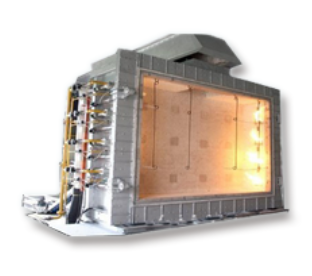
GH-JR-NJW-FJ Horizontal Refractory Furnace


Introduction
This test furnace simulates the actual temperature rise process during a fire, meeting the requirements for conducting fire resistance limit tests on specimens to comprehensively evaluate the weathering performance of structural components.
Standards
(1)ISO 834-1:2025 Fire-resistance tests — Elements of building construction Part 1: General requirements
(2)GB/T 9978.1-2008 —Fire Resistance Test Methods for Building Components—Part 1: General Requirements
(3)GB/T 9978.3-2008 — Fire Resistance Test Methods for Building Components—Part 3: Notes on Test Methods and Application of Test Data
(4)GB/T 9978.5-2008—Fire Resistance Test Methods for Building Components - Part 5: Special Requirements for Load-bearing Horizontal Partition Components
(5)GB/T 9978.6-2008—Fire Resistance Test Methods for Building Components - Part 6: Special Requirements for Beams
(6)GB/T 9978.7-2008—Fire Resistance Test Methods for Building Components - Part 7: Special Requirements for Columns
(7)EN 1363-1 Fire resistance tests - Part 1: General Requirements
(8)EN 1363-2 Fire resistance tests - Part 2: Alternative and additional procedures
(9)EN 1364-1 Fire resistance tests for non-loadbearing elements - Part 1: Walls
(10)EN 1364-2 Fire resistance tests for non-loadbearing elements - Part 2: Ceilings
(11)EN 1365-1 Fire resistance tests for loadbearing elements Part 1 : Walls
(12)EN 1365-2 Fire resistance tests forloadbearing elements Part 2: Floors and roofs
(12)EN 1634-1 Fire resistance tests for door and shutter assemblies
Technical Parameters
Parameter | Specification |
Furnace Type | Horizontal refractory furnace |
Chamber Size | 4.0m × 4.0m × 2m |
Fuel | Natural gas |
Maximum Operating Temperature | 1300℃ |
Number of Burners | 10 sets |
Total Gas Consumption | ≤300m³/h |
Exhaust Gas Temperature | ≤280℃ |
Exhaust Air Volume | ≈20000m³/h |
Furnace Wall Temperature | ≤45℃ |
Insulation Material | Built-in chromium-containing cotton modules |
Thermocouples | 12 in-furnace thermocouples, 48 warm-zone thermocouples, 1 movable thermocouple, 1 ambient thermocoupleThermocouples comply with GB/T 16839.1: Type K (nickel-chromium/nickel-silicon) with φ2mm diameter, fitted with heat-resistant steel outer sleeves and ceramic inner sleeves. Protrusion length from sleeve ≥25mm- In-furnace range: 0℃~1300℃, accuracy: ±15℃- Backside surface range: 0℃~800℃, accuracy: ±4℃- Movable range: 0℃~900℃, accuracy: ±4℃- Ambient range: -10℃~100℃, accuracy: ±1℃ |
Observation Windows | 2 on the rear wall of the furnace body |
Combustion Control Mode | Proportional combustion, automatic pressure control, automatic temperature adjustment, temperature curve program control, computer-assisted management |
Exhaust Mode | Rear-wall mechanical exhaust |
Computer Configuration | Tsinghua Tongfang |
Equipment Structure and Description
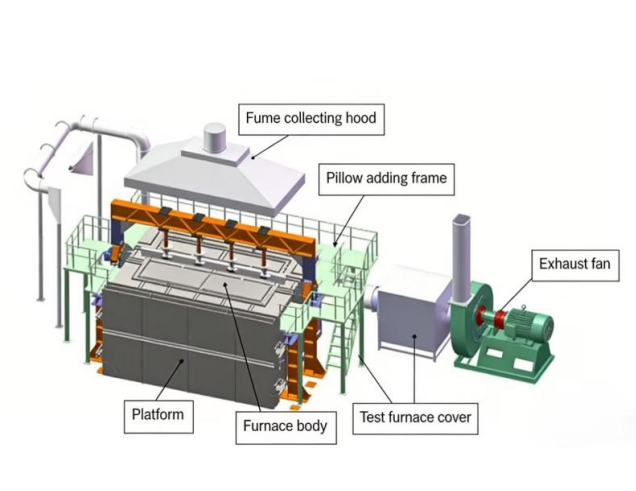
The complete set of equipment includes a furnace body conforming to GB/T 9978.1-2008, a test frame, a smoke exhaust and air supply system, a test control system (including data acquisition system, thermocouples, furnace pressure control system, deformation measurement system, and video recording and photography system), an integrity measuring instrument, a combustion and gas supply system, and a servo hydraulic loading system. It features calibration functions to ensure that the temperature and pressure values and distribution meet the standard requirements.
Furnace Structure
The internal dimensions of the furnace are 4200mm (D) × 3000mm (W) × 2000mm (H). The total height of the furnace including the fume hood is 5.3m. The main body of the test furnace adopts a steel structure
frame. The furnace lining material uses high-temperature resistant insulation material with a density of less than 1000 kg/m³. The thickness of the furnace lining material is not less than 300mm.
Steel Structure & Material Parameters
Serial No. | Steel Structure | Material Parameter |
1 | Furnace Body Steel Plate | Material: Q235, wall thickness: 4mm |
2 | Furnace Body Column | Material: Q235, channel steel |
3 | Furnace Body Frame | Material: Q235, channel steel / I-beam / rectangular tube |
4 | Furnace Wall Reinforcement Bar | Material: Q235, channel steel |
Furnace Body Refractory Materials
The furnace body uses refractory fiber insulation, with a minimum thickness of 300mm. The maximum operating temperature is 1430℃, and the long-term working temperature is no less than 1400℃. The linear shrinkage after firing at 1400℃ is less than 0.5%, and the thermal conductivity is better than 0.4 W/m·K. Industrial refractory adhesive is used for bonding, with a service temperature of no less than 1400℃.
Parameter | Specification |
Chemical Composition | Al₂O₃ ≥ 35%, average: 35.1; SiO₂ ≥ 55%, average: 49.7; ZrO₂ ≥ 13%, average: 15 |
Operating Temperature | 1400℃ |
Bulk Density (kg/m³) | ≥ 210, average: 210 |
Linear Change Rate (%) | ≤ 0.5% |
Thermal Conductivity (W/m·K) | - At average temperature 600℃: ≤ 0.14 (0.16), typical: 0.12 (0.14)- At average temperature 800℃: ≤ 0.22 (0.25), typical: 0.17 (0.20)- At average temperature 1000℃: ≤ 0.32 (0.37), typical: 0.24 (0.28) |
Leave Message Get Price