Male Side Impact Dummy (RE Type)
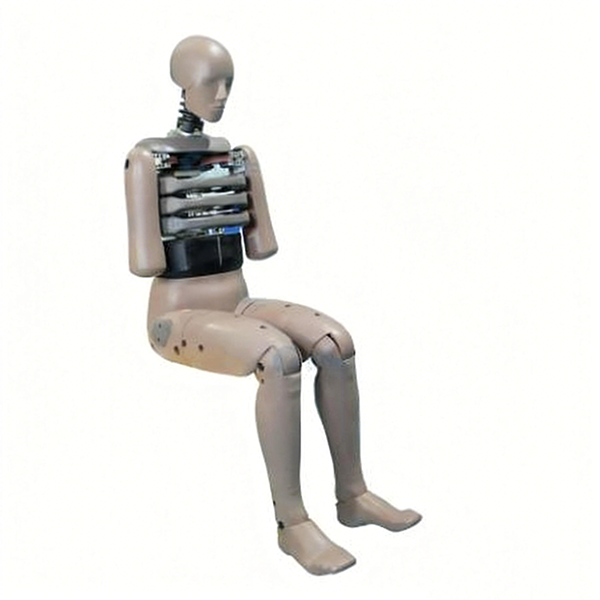


The Male Side Impact Dummy (RE Type) is a high-fidelity side impact test dummy designed based on 50th percentile adult male anthropometric data. It is used to simulate biomechanical responses of occupants during vehicle side collisions, accurately representing chest, pelvis, and lower limb acceleration, load, and displacement. The dummy features an enhanced rib structure with a rib extension mechanism, enabling realistic interaction with seats and door panels. It is suitable for regulatory testing, NCAP evaluation, and vehicle passive safety development.
Application
(1) Side impact occupant protection assessment for passenger cars and commercial vehicles;
(2) Evaluation of vehicle side structures (doors, B-pillars, sill beams, etc.) crashworthiness;
(3) Verification of side airbags, curtain airbags, and occupant restraint systems;
(4) Regulatory certification and consistency verification tests;
(5) Side impact safety development for new and modified vehicle models;
(6) Research on lateral protection performance of automotive components (seats, interior panels, energy-absorbing structures);
(7) Automotive safety research and university laboratory experiments.
Standards
(1) GB/T 11551 – Protection of occupants in frontal and side collisions
(2) GB 14166 – Motor vehicle seat belts and restraint systems
(3) FMVSS 214 – Side impact protection
(4) UNECE R95 – Lateral collision protection
(5) UNECE R135 – Pole side impact
(6) SAE J1727 – Side impact dummy performance specification
(7) ISO 15830 – Road vehicles – Side impact dummy – Calibration
(8) Euro NCAP – Side impact test protocol
Parameters
Dimensional Data
| No. | Item | Dimension (mm) |
|---|---|---|
| 1 | Sitting height | 909 ±9 |
| 2 | Seat to shoulder | 565 ±7 |
| 3 | Seat to bottom of thorax box | 351 ±5 |
| 4 | Seat to hip joint (bolt center) | 100 ±3 |
| 5 | Foot to seat height (sitting) | 442 ±9 |
| 6 | Head width | 155 ±3 |
| 7 | Shoulder breadth | 470 ±9 |
| 8 | Chest width | 327 ±5 |
| 9 | Abdomen width | 280 ±7 |
| 10 | Pelvis width | 366 ±7 |
| 11 | Head depth | 201 ±5 |
| 12 | Chest depth | 267 ±5 |
| 13 | Abdomen depth | 199 ±5 |
| 14 | Pelvis depth | 240 ±5 |
| 15 | Rear pelvis to hip joint (bolt center) | 155 ±5 |
| 16 | Rear pelvis to front knee | 606 ±9 |
Mass Distribution
| Component | Mass (kg) |
|---|---|
| Head | 4 ±0.05 |
| Neck | 1 ±0.05 |
| Thorax | 22.4 ±1 |
| Left arm | 1.3 ±0.1 |
| Right arm | 1.3 ±0.1 |
| Abdomen | 5 ±0.25 |
| Pelvis | 12 ±0.6 |
| Left leg | 12.7 ±0.6 |
| Right leg | 12.7 ±0.6 |
| Total | 72.4 ±1.2 |
Sensor Configuration
| Location | Sensor Type | Channels |
|---|---|---|
| Head | Accelerometer | 3×1 |
| Head | Gyroscope | 3×1 |
| Upper Neck | 6-channel load cell | 1×6 |
| Lower Neck | 6-channel load cell | 1×6 |
| Shoulder | 3-channel load cell | 1×3 |
| Thorax | Tilt sensor | 1×2 |
| Torso | 4-channel load cell | 1×4 |
| Thoracic T1 | Accelerometer | 1×3 |
| Thoracic T12 | Accelerometer | 3×1 |
| Ribs | Accelerometer | 3×1 |
| Ribs | Linear potentiometer | 3×1 |
| Thoracic T12 | 4-channel load cell | 1×4 |
| Abdomen | Single-channel load cell | 3×1 |
| Lower lumbar | 3-channel load cell | 1×3 |
| Pelvis | Tilt sensor | 1×2 |
| Pubis | Single-channel load cell | 1×1 |
| Sacrum | Accelerometer | 3×1 |
| Thigh | 6-channel load cell | 1×6 |
Features
(1) Designed based on 50th percentile adult male anthropometry for high biofidelity;
(2) Enhanced rib structure with rib extension mechanism for realistic chest lateral compression and displacement;
(3) Accurate interaction with seats and door panels;
(4) Supports multi-channel force, acceleration, and displacement measurement;
(5) Stable structure suitable for regulatory and high-repetition tests;
(6) Compatible with multiple international side impact regulations and NCAP protocols.
Accessories
(1) High-precision accelerometer set
(2) Load cell and displacement sensor modules
(3) Rib extension mechanism
(4) Replaceable limb modules (arms, legs, torso)
(5) Data acquisition interfaces and calibration tools
(6) Dedicated transport frame and mounting base
Maintenance Information
(1) Regularly inspect ribs, thorax, and pelvis for cracks or damage;
(2) Check sensor connections and data acquisition interfaces;
(3) Lubricate and secure detachable limb and joint modules;
(4) Keep dummy surfaces clean and free of corrosive agents;
(5) Store in controlled environment avoiding high humidity, temperature, and UV exposure;
(6) Record usage and maintenance history after each test.
FAQ
(1) What is the purpose of a Male Side Impact Dummy in vehicle testing?
The dummy simulates human occupant behavior during side collisions and measures biomechanical responses such as chest deformation, acceleration, and impact force. The collected data helps engineers evaluate vehicle structures, airbags, and restraint systems to improve occupant protection performance.
(2) Which vehicle tests can use this side impact dummy?
The dummy is mainly used for passenger vehicle and commercial vehicle side impact evaluations, including door impact, pole impact-related research, and restraint system validation. It supports development testing as well as certification and NCAP-related safety assessments.
(3) What sensors are integrated into the RE Type side impact dummy?
The dummy can be equipped with sensors for measuring head acceleration, neck loads, rib movement, chest response, pelvis behavior, and lower limb forces. These measurements provide detailed occupant injury analysis data during crash simulations.
(4) How can testing accuracy be maintained during long-term use?
Regular calibration, proper storage, and inspection of mechanical parts and sensors are essential for maintaining accuracy. QINSUN equipment solutions are checked before delivery to ensure stable performance and reliable data collection during testing.
(5) How can I select the suitable crash test dummy configuration for my project?
Different vehicle programs may require different dummy types, sensor configurations, and compliance standards. QINSUN engineers can provide selection guidance, application solutions, and related testing cases according to your vehicle safety evaluation requirements.
Leave Message Get Price