5th Percentile Female Crash Test Dummy
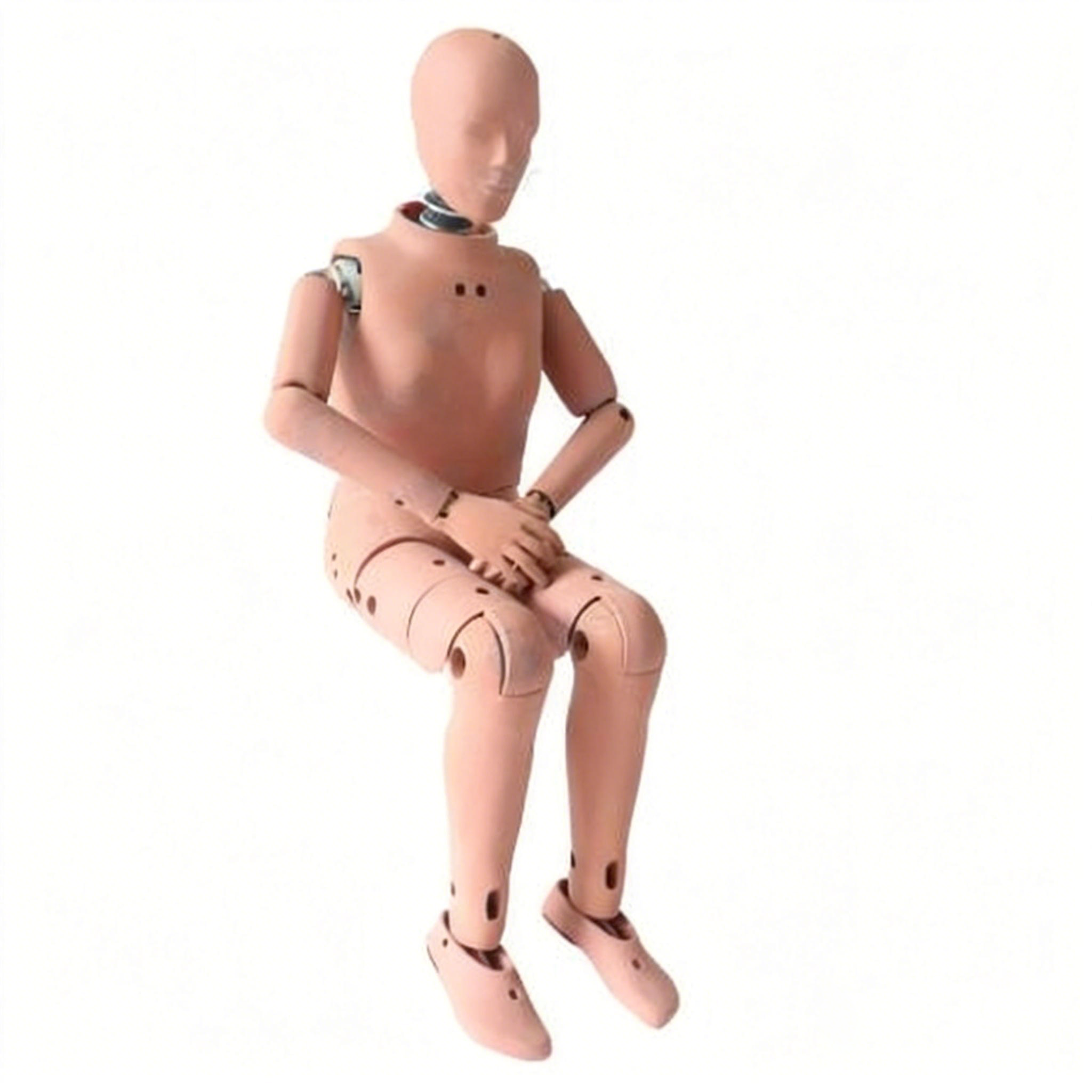


The 5th Percentile Female Crash Test Dummy serves as a surrogate for a real human in frontal automotive crash tests. It is designed based on anthropometric data and body mass characteristics of the 5th percentile adult female population. The dummy consists of anatomically corresponding components, including the head, neck, chest, upper arms, torso, legs, feet, and outer clothing. Its structure integrates metal and plastic skeletons with rubber, foam, and plastic coverings to simulate muscle and tissue, providing realistic impact response. During testing, acceleration, load, and displacement sensors are installed at specific internal positions to measure dynamic responses under frontal collision conditions, enabling detailed performance analysis.
Application
You can use the 5th Percentile Female Dummy in the following scenarios:
Frontal crash occupant injury assessment
Customer evaluation and research purposes
Specific applications include:
C-NCAP, UN R137, FMVSS 208, Euro NCAP, US-NCAP, IIHS, J-NCAP, K-NCAP, ANCAP testing
Passenger car and commercial vehicle frontal crash safety evaluation
Seatbelt restraint system performance and injury assessment
Frontal airbag deployment characteristics and protection effectiveness
Dashboard, steering, and pedal impact analysis for small-stature occupants
Injury risk and biomechanical response studies of small female occupants
Development, calibration, and comparative validation of passive safety systems
Regulatory compliance testing, third-party evaluation, and academic research
Standards
The dummy complies with a wide range of international and national standards:
(1) GB 11551 – Protection of occupants in frontal collisions
(2) GB/T 29120 – Anthropomorphic test device general technical requirements
(3) GB/T 24550 – Frontal crash test methods
(4) ISO 6487 – Road vehicles — Measurement techniques in impact tests
(5) SAE J211 – Instrumentation for impact tests
(6) SAE J826 – Vehicle occupant seating reference points
(7) FMVSS 208 – Occupant crash protection
(8) ECE R94 / ECE R16 – Vehicle safety standards
(9) NCAP frontal crash test protocols (US NCAP / C-NCAP / Euro NCAP)
Parameters
Dimensions
| No. | Name | Dimension (mm) |
|---|---|---|
| A | Seated Height | 787.4 ±12.7 |
| B | Shoulder Pivot Height | 444.5 ±12.7 |
| C | H-Point Height (Reference) | 83.8 ±2.5 |
| D | H-Point to Seatback (Reference) | 147.3 ±2.5 |
| E | Shoulder Pivot to Backplane | 76.2 ±7.6 |
| F | Thigh Thickness | 127.0 ±7.6 |
| G | Elbow to Wrist | 251.5 ±7.6 |
| H | Head Rear to Backplane | 45.7 ±2.5 |
| I | Shoulder to Elbow | 287.0 ±10.2 |
| J | Elbow to Seat Plane | 193.0 ±10.2 |
| K | Knee Front to Backplane | 533.4 ±12.7 |
| L | Foot to Seat Plane | 365.8 ±10.2 |
| M | Knee Pivot to Floor | 406.4 ±12.7 |
| O | Chest Thickness (No Skin) | 182.9 ±12.7 |
| P | Foot Length | 226.1 ±7.6 |
| R | Hip to Knee Pivot | 469.9 ±12.7 |
| U | Hip Width | 307.3 ±7.6 |
| V | Shoulder Width | 358.1 ±7.6 |
| W | Foot Width | 86.4 ±7.6 |
| Y | Chest Circumference | 866.1 ±15.2 |
| Z | Waist Circumference | 774.7 ±15.2 |
| AA | Chest Reference Position | 345.4 ±12.7 |
| BB | Waist Reference Position | 165.1 ±5.1 |
Mass Distribution
| Component | Mass (kg) |
|---|---|
| Head Assembly | 3.73 ±0.05 |
| Neck Assembly | 0.91 ±0.09 |
| Upper Torso with Chest Skin | 12.02 ±0.14 |
| Lower Torso | 13.25 ±0.14 |
| Upper Arm (L/R) | 1.18 ±0.05 |
| Lower Arm (L/R) | 0.90 ±0.05 |
| Hands (L/R) | 0.28 ±0.05 |
| Thigh (L/R) | 3.13 ±0.09 |
| Lower Leg (L/R) | 3.27 ±0.09 |
| Feet (L/R) | 0.79 ±0.05 |
| Total Dummy Weight | 49.05 ±1.13 |
Sensor Configuration
| Location | Sensor Type | Channels | Requirement |
|---|---|---|---|
| Head | Accelerometer | 3x1 | ★★★ |
| Upper Neck | 6-axis Load Cell | 1x6 | ★★★ |
| Lower Neck | 6-axis Load Cell | 1x6 | ★ |
| Chest | Accelerometer | 3x1 | ★★★ |
| Chest | Displacement Sensor | 1x1 | ★★★ |
| Sternum | Accelerometer | 3x1 | ★ |
| Spine | Accelerometer | 3x1 | ★ |
| Lumbar | 6-axis Load Cell | 1x6 | ★★★ |
| Pelvis | Accelerometer | 3x1 | ★★★ |
| Iliac | Iliac Force Sensor | 2x2 | ★★★ |
| Thigh | Single-axis Force Sensor | 2x1 | ★★★ |
| Knee | Displacement Sensor | 2x1 | ★★★ |
| Knee | 2-axis Force Sensor | 2x2 | ★ |
| Upper Tibia | 4-axis Force Sensor | 2x4 | ★★★ |
| Lower Tibia | 4-axis Force Sensor | 2x4 | ★★★ |
Features
(1) Designed strictly based on anthropometric data of 5th percentile adult females for high representativeness
(2) Metal skeleton and engineering plastic structure, covered with rubber, foam, and skin-like materials for realistic biofidelity
(3) Head, neck, chest, pelvis, and lower limb impact response meets biomechanical requirements
(4) Supports multi-channel high-precision sensors for regulatory and R&D testing
(5) Modular design allows easy maintenance, calibration, and sensor replacement
(6) Suitable for regulatory testing, NCAP evaluation, and full-vehicle safety research
Accessories
(1) Sensor kits (accelerometers, load cells, displacement sensors)
(2) Calibration tools and jigs
(3) Protective clothing and covers
(4) Mounting adapters and fixtures
(5) Maintenance toolset
Test Procedures
(1) Inspect all joints, connections, and skin for structural integrity before testing
(2) Adjust seating posture and H-point according to standard requirements
(3) Follow specific seatbelt paths and seating configurations for each NCAP or regulatory protocol
(4) Install, zero, and calibrate sensors in compliance with ISO 6487
(5) Inspect critical components and sensors after the crash test and perform necessary maintenance
Maintenance Information
Regularly check for wear or damage on joints, skin, and structural elements
Calibrate all sensors periodically to maintain accuracy
Clean and store the dummy in a controlled environment to prevent material degradation
Replace worn components promptly to ensure reliable testing results
FAQ
(1) What is this product?
It is a 5th percentile adult female crash test dummy used for frontal automotive collision testing.
(2) What is this product used for?
You use it to assess injury risk, evaluate safety systems, and support vehicle safety research and regulatory testing.
(3) How does this product work?
By replicating human body dimensions and mass, the dummy measures acceleration, load, and displacement through integrated sensors during crash tests.
(4) Why is this product important?
It ensures small-stature female occupants are represented in safety assessments, enabling better design of restraint systems, airbags, and vehicle interiors.
(5) Which industries is this product suitable for?
Automotive OEMs, crash test laboratories, safety research institutions, regulatory testing agencies, and academic research facilities.
Leave Message Get Price