

Dry Fallen Wadding Tester — YY/T 0506.6 | ISO 9073-10 | EN 13795-2

The Dry Fallen Wadding Tester is specially designed to evaluate the lint-shedding performance of medical nonwoven raw materials and other textile materials under dry conditions. It is widely used for testing shedding behaviors of surgical drapes, surgical gowns, cleanroom garments, and other protective medical textiles.
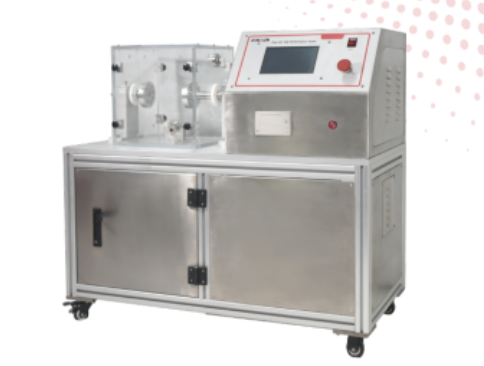
During the test, the sample undergoes combined torsion and compression inside a sealed chamber while air is extracted and analyzed by a laser particle counter. The system measures and classifies airborne particles to determine the material’s cleanliness and shedding characteristics.
How It Works
The testing process places the sample under repeated torsion and compression. As particles detach, they are carried by airflow and counted with a high-precision laser particle counter. The instrument can monitor 8 particle-size channels simultaneously, storing up to 10×500 sets of data. It is suitable for particulate matter evaluation, indoor air cleanliness studies, filter efficiency testing, and cleanroom-quality assessments.
Standards Compliant
YY/T 0506.6 – Surgical drapes, gowns and clean air suits – Part 4: Dry linting test
ISO 9073-10 – Textiles and nonwovens test method – Part 10: Lint and other particles generated in a dry state
EN 13795-2 – Surgical drapes and gowns – Test methods
Major Features
Smart Touch Control System
Equipped with a 7-inch color touch screen and microcomputer control for easy operation. Functions include test control, particle detection, data storage, calculation, and printing.
Transparent Anti-Static Test Chamber
The test chamber is made of special transparent anti-static material, preventing particle adsorption and allowing real-time observation of the test process.
Compact and Precise Mechanical Structure
The mechanical system ensures stable torsion, compression, and resetting of samples, fully meeting testing standards. The machine delivers high repeatability and reliable data accuracy.
Field Application
The Dry Fallen Wadding Tester is commonly used for evaluating lint-shedding of medical nonwoven materials, including surgical drapes, gowns, and cleanroom garments.
It is suitable for QC departments, R&D labs, third-party testing agencies, performance-verification laboratories, and institutions responsible for regulatory supervision.
Technical Parameters
| Parameter | Specification |
|---|---|
| Control Mode | Smart touch |
| Air Sampling Flow | 28.3 L/min |
| Test Speed | 60 cycles/min |
| Sampling Time | 0.5–10 min (20 options) |
| Rotation Angle | 180° per cycle (alternating direction) |
| Sampling Volume Options | 14.15 L – 283 L (20 levels) |
| Disk Diameter | Φ82.8 mm |
| Minimum Particle Size | 0.3 μm |
| Starting Distance | Between two discs |
| Interval Time | 1–10 s (10 options) |
| Moving Plate Stroke | Linear |
| Max Allowed Sample Concentration | 35,000 / L |
| Particle Channels | 0.3 / 0.5 / 0.7 / 1.0 / 2.0 / 5.0 / 7.0 / 10.0 μm |
| Weight | 55 kg |
| Power Supply | AC 220V, 50Hz |
| Dimensions | 85 cm × 60 cm × 90 cm |
FAQ
What is a Dry Fallen Wadding Tester?
It is an instrument used to measure how easily textile or nonwoven materials shed lint and particles under dry mechanical stress.
Why is dry lint shedding important?
In medical environments, excessive shedding can cause contamination risks during surgery or cleanroom operations. Therefore, materials must meet strict cleanliness standards.
What materials can be tested?
Medical nonwovens, surgical drapes, gowns, cleanroom garments, textile raw materials, and related protective fabrics.
How does the tester measure particles?
A laser particle counter collects airborne particles generated during sample twisting and compression, classifying them into 8 particle-size groups.
Where is this instrument used?
Hospitals, medical textile manufacturers, nonwoven suppliers, QC departments, third-party labs, and regulatory bodies.
2025-12-08 17:42
- Related News
How to Choose a Suitable Drying Rate Tester?
What Is a Fabric ICI Pilling and Snagging Box?
How to Choose an ICI Mace Snag Tester?
What a Fiber Oil Extractor Actually Does?
Snap Button Pull Tester: Garment Accessory Tensile Strength Testing Guide
Guide to Block-on-Ring Friction Wear Equipment
How to Choose Universal Multifunction Tribology Test Machine
How to Choose an Air-Cooled Xenon Lamp Aging Chamber
What Does an Ozone Aging Chamber Test? Standards and Operating Methods
Fabric Cool Feeling Tester: Working Principle, Standards and Selection Guide