Automotive Cargo Cover Screw Inspection Line
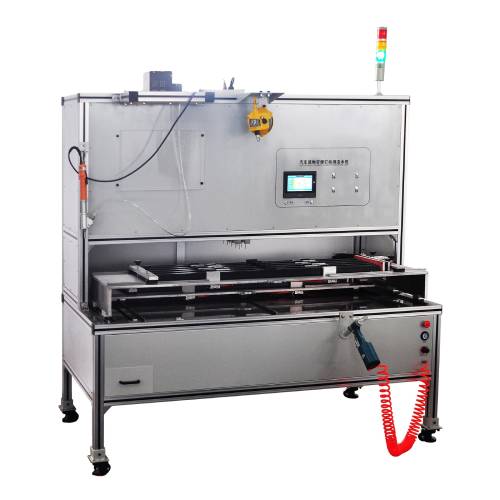


The Automotive Cargo Cover Screw Inspection Line is an automated system designed to inspect the installation status of screws in automotive cargo covers and interior components. It ensures that screws are correctly positioned and securely installed, providing real-time verification of assembly quality. By integrating advanced vision and sensor technologies, the system enhances inspection efficiency, ensures product consistency, and minimizes human error in the production process.
Application
This inspection line is primarily used in automotive interior manufacturing for the following applications:
Detecting screw installation in cargo covers, dashboards, and other interior panels
Verifying the presence, position, and stability of screws in mass production
Supporting automated assembly lines with integrated screw detection and quality assurance
Compatible with production setups where high-speed, repeatable inspection is required
Standards
The system aligns with or supports adherence to relevant international and industry standards, including:
ISO 9001 – Quality Management Systems
ISO/TS 16949 – Automotive Quality Management
IEC 61010 – Safety Requirements for Electrical Equipment
ISO 2768 – General Tolerances for Linear and Angular Dimensions
ISO 12100 – Safety of Machinery – Risk Assessment and Risk Reduction
JIS B 1160 – Automotive Fastener Standards
Features
Automated Screw Status Detection: Identifies missing, misaligned, or improperly fastened screws instantly.
Real-Time Judgement & Feedback: Inspection results are output immediately, allowing integration with assembly lines for automatic rejection of defective products.
Programmed Control: Supports combined screw installation and detection operations, minimizing manual intervention.
Batch Production Efficiency: Reduces labor intensity while ensuring consistent product quality.
Compact Layout & Workflow Optimization: Multiple detection stations can be integrated on a single platform, saving space and improving production flow.
Accessories
Vision camera modules or optical sensors
PLC controller and HMI interface
Screw feeder hopper with low-stock sensor
Light barriers for detection and NG channel
Barcode scanner for material verification
Pneumatic blow tubes for screw placement
Alarm and signal lights for fault indication
Test Procedures
Closed-Loop Supply Control
Use PLC and ring-type photoelectric sensors at screw entry and exit points. Signal triggers the locking operation; otherwise, an alarm is issued.
The low-stock sensor in the hopper automatically triggers replenishment to prevent missed supply.
Accurate Detection and Error Prevention
Long/short screw detection uses paired through-beam fiber optics; screws passing through the defined optical zone are accepted, otherwise rejected to NG channel.
Barcode scanning ensures only the correct screw type is supplied.
Optimized Layout and Feed Rate
Adjust vibration frequency to maintain stable feed, achieving standard screw supply speeds of 40 pcs/min or higher.
Minimize the travel distance in blow-tube layout to avoid screw misrouting.
Test feed rhythm to match actual production line pace.
Maintenance Information
Regularly clean vision sensors, optical fibers, and camera lenses to prevent dust interference.
Inspect and lubricate moving parts and vibratory feeders monthly.
Check PLC signal integrity and HMI functionality periodically.
Ensure pneumatic blow tubes and air supply are free of obstruction.
Calibrate detection thresholds according to screw specifications to maintain accuracy.
FAQ
1. What is the main function of the Automotive Cargo Cover Screw Inspection Line?
The Automotive Cargo Cover Screw Inspection Line is an automated system designed to inspect screws in automotive cargo covers and interior components. It ensures that screws are correctly positioned, securely fastened, and conform to assembly quality standards. By using vision and sensor technologies, it provides real-time verification of screw installation, reduces human error, and improves overall production efficiency. The system can immediately identify missing, misaligned, or loose screws and trigger alerts or automated rejection of defective products.
2. How does the system detect screw installation?
The system uses a combination of vision cameras and optical/laser sensors to detect the presence, position, and tightness of screws. Long and short screws are monitored using paired through-beam fiber optics. When a screw passes through the defined optical zone, it is accepted; otherwise, it is rejected to the NG (non-conforming) channel. Barcode scanning is also integrated to verify that the correct screw type is supplied. The system works in real-time and is fully compatible with automated assembly lines.
3. What applications is this inspection line suitable for?
This inspection line is primarily used in automotive interior manufacturing. It inspects screws in cargo covers, dashboards, and other interior panels. It supports high-speed, mass production setups where repeatable and accurate screw detection is essential. By integrating automated inspection, the system ensures consistent quality while reducing labor intensity, making it ideal for assembly lines requiring efficiency and precision.
4. What standards does the inspection line comply with?
The system aligns with several international and industry standards, including ISO 9001 for quality management, ISO/TS 16949 for automotive quality, IEC 61010 for electrical safety, ISO 2768 for linear and angular tolerances, ISO 12100 for machinery safety, and JIS B 1160 for automotive fastener standards. Compliance with these standards ensures that the inspection process meets safety, accuracy, and reliability requirements in automotive manufacturing.
5. How is maintenance of the inspection line performed?
Regular maintenance includes cleaning vision sensors, optical fibers, and camera lenses to prevent dust interference. Moving parts and vibratory feeders should be inspected and lubricated monthly. PLC signals and HMI interfaces should be checked for proper functionality. Pneumatic blow tubes and air supply lines must remain unobstructed. Detection thresholds should be recalibrated according to screw specifications to maintain accurate inspection results. Regular maintenance ensures consistent inspection
Leave Message Get Price