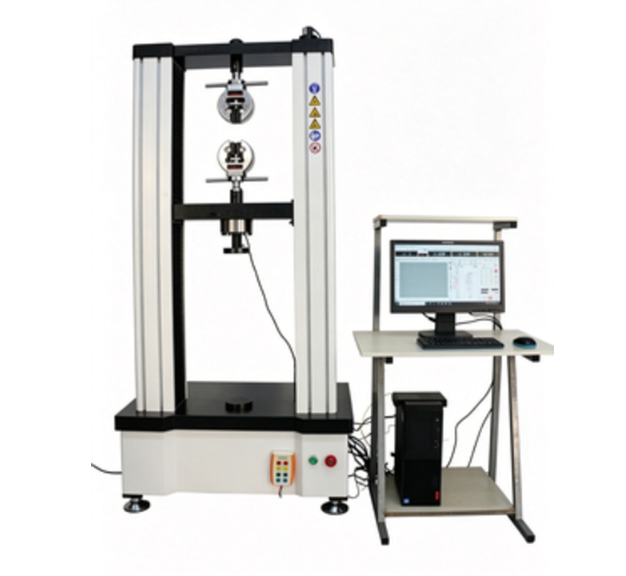
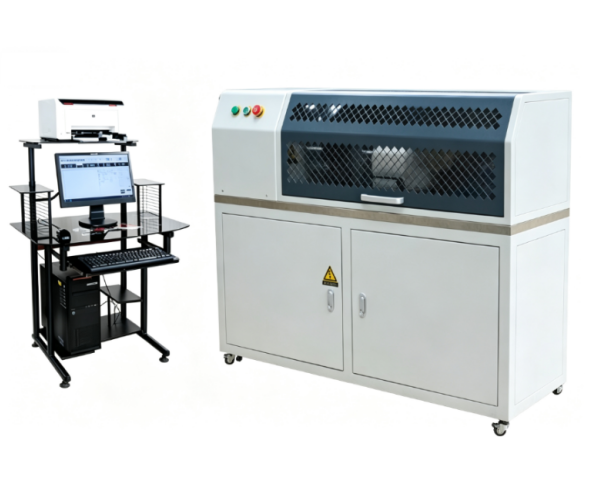
Automotive Headrest and Backrest Static Strength Testing Machine
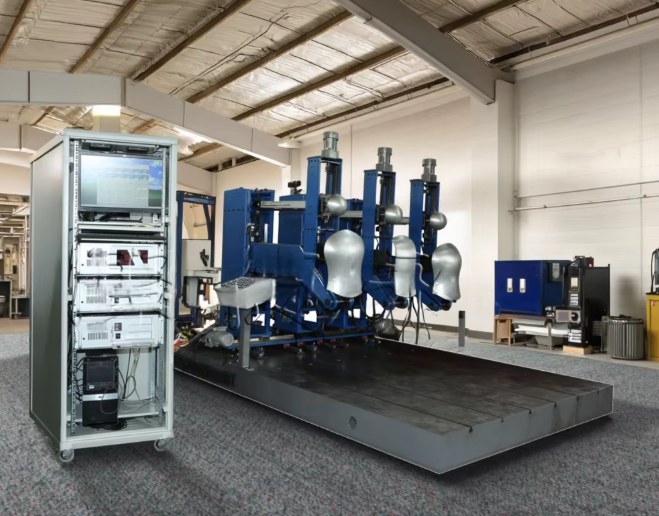


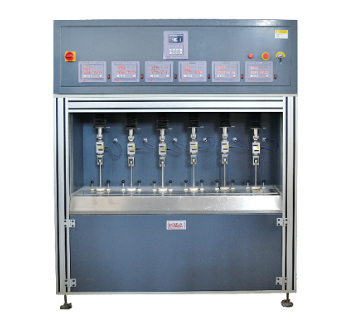
The Automotive Seat Three-Station Headrest and Backrest Static Strength Testing Machine is designed to evaluate the static strength of vehicle seat headrests and backrests. You can use this system to perform assessments on new seat designs, process modifications, material changes, supplier validation, and quality control inspections. It allows for precise, repeatable measurement of load and displacement under controlled conditions, ensuring compliance with automotive safety standards.
Application
This testing machine is suitable for a variety of scenarios in automotive seat design and validation:
Headrest Static Strength Testing: Assess headrest durability and safety under static load.
Backrest Static Strength Testing: Evaluate seatback structural integrity under static load.
Design Verification: Validate new seat designs or material modifications.
Supplier Assessment: Perform qualification and batch inspections of seat components.
Quality Control: Monitor production consistency and ensure compliance with automotive standards.
Typical products tested include automotive seats, headrests, and seatbacks from passenger vehicles, commercial vehicles, and railway seats.
Standards
The machine supports compliance with major international and national standards:
GBI 5083-2019 – Automotive seats, seat anchorage, and headrest strength requirements and test methods.
ECE R17 – Automotive seat and headrest strength test methods and safety requirements.
Parameters
| Parameter Category | Details | Specifications |
|---|---|---|
| Machine Dimensions | Main Test Frame | 3500 × 2000 × 2200 mm |
| Control Cabinet | 600 × 600 × 1800 mm | |
| Power Distribution Cabinet | 800 × 600 × 1000 mm | |
| Power Supply | - | Single-phase AC 220 V, 50 Hz, 5 kW |
| Servo Electric Cylinders | Quantity & Purpose | 9 cylinders total, 6 for headrest/backrest static strength |
| Stroke & Accuracy | 600 mm, ±1% displacement, resolution 0.01 mm | |
| Maximum Thrust & Accuracy | 2 kN, ±1%, resolution 0.1 N | |
| Loading Position | 290 ± 0.25 mm above H-point | |
| Load Sensors | Capacity & Quantity | 2 kN, 6 sensors |
| Accuracy | ±1% | |
| Rated Output | 3 mV/V ± 0.025% | |
| Nonlinearity | 0.5% | |
| Non-repeatability | 0.2% | |
| Optical Encoder Displacement Sensors | Quantity | 9 pcs |
| Linearity | 0.05% F.S. | |
| Repeatability | 0.1% | |
| Other Parameters | Sampling Frequency | 2 kHz |
| Measurement Accuracy | Better than ±1% | |
| Control Accuracy | Better than ±1% |
Features
Full-range load capability without gear segmentation; adjustable loading speed.
High-performance servo electric cylinders with real-time automatic gain adjustment; adaptive filters enable testing from low to high stiffness automatically.
Measurement and control system uses NI high-performance motion control cards; modular and standardized architecture ensures flexibility, interchangeability, and easy maintenance.
Test data stored in a secure database with high confidentiality.
Software allows manual selection of curve points, slope calculation between points, curve scaling and shifting, and export of all sampled points to Excel; multiple curves can be overlaid for batch comparison and custom Excel report generation.
Simple calibration of load and displacement for user-friendly operation.
Modular design of the measurement and control system for easy maintenance.
Safety features include limit protection, overload protection, and software-set protection.
Accessories
Control and motion software suite (pre-installed).
Load cell calibration kit.
Optical encoder calibration fixtures.
Safety shields and limit switches.
Installation and operation manual.
Maintenance Information
Inspect servo cylinders, load sensors, and optical encoders regularly for wear or damage.
Calibrate load cells and displacement sensors periodically.
Keep the control cabinet and electronics free of dust and moisture.
Ensure all moving parts are lubricated according to the maintenance schedule.
Verify safety limit switches and overload protection functionality.
FAQ
1. What is this product?
It is a three-station testing machine designed to measure the static strength of automotive seat headrests and backrests.
2. What is it used for?
You can use it to assess seat safety, validate designs, check material changes, and perform quality control on seat components.
3. How does it work?
The machine applies a precisely controlled static load via servo electric cylinders while measuring load and displacement with high-precision sensors.
4. Why is it important?
It ensures that automotive seats meet regulatory strength requirements, providing occupant safety and design reliability.
5. Which industries is it suitable for?
Automotive OEMs, seat suppliers, railway seat manufacturers, and any laboratory involved in automotive seating testing and quality verification.
Leave Message Get Price