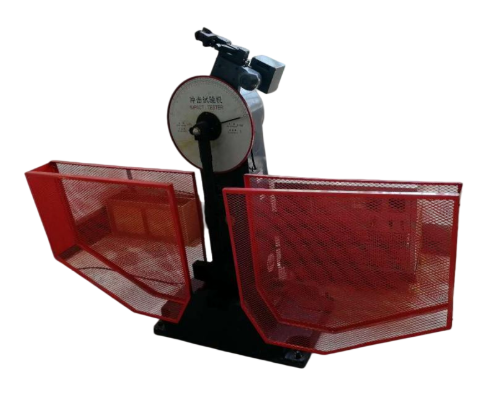
Pendulum Impact Tester


Introduction
The Pendulum Impact Tester is a product developed strictly according to the national standard GB/T3808-2002 "Inspection of Pendulum Impact Testing Machines". It performs impact tests on metallic materials according to the national standard GB/T229-1994 "Metallic Materials Charpy Impact Test Method" and undergoes factory inspection according to JJG145-82 "Pendulum Impact Testing Machine". The sample cross-section used is 10*10MM. It is mainly used for testing ferrous metals with high impact toughness, especially steel and its alloys.
The testing principle of this product is based on the difference between the potential energy before and after the impact of the pendulum, displayed on a dial, to obtain the absorbed work of the tested sample.
Application
The Pendulum Impact Tester is widely used in testing, research and production in industries such as metrology, machinery manufacturing, metallurgy, pressure vessels, and universities.
Working conditions
(1) Ambient temperature: 10-35ºC;
(2) Relative humidity: not greater than 85%;
(3) Environment free from corrosive media;
(4) Installed on a concrete foundation with a thickness of not less than 150mm or fixed on a foundation with a weight of more than 880 kg;
(5) The levelness of the mounting reference surface on the base is adjusted to within 0.2/1000.
Parameters
Item | Specification |
Impact energy | 300J, 150J |
Dial scale range and graduation value | Energy range: 0–300J, 0–150J Graduation value per small grid: 2J, 1J |
Pendulum torque | Impact energy: 300J, 150J Pendulum torque: 160.7695N·M, 80.3848N·M |
Pendulum pre-raise angle | 150° |
Distance from pendulum center to impact point (test center) | 750mm |
Impact speed | 5.2m/s |
Distance between sample supports | 40mm |
Arc radius of sample support end | 1–1.5mm |
Support surface inclination angle of sample support | 0° |
Arc radius of impact knife | 2–2.5mm |
Angle between two bevels of impact knife | 30° |
Thickness of impact knife edge | 16mm |
Sample specification | 10×10×55mm |
Net weight of testing machine | Approx. 45kg |
Overall dimension of testing machine | 2124×600×1340mm |
Power supply | Three-phase 50Hz, 380V/250W (main motor) |
Standard configuration
Item | Specification | Quantity | Remarks |
Main unit | — | 1 set | — |
Pendulum | Large pendulum: 300J; Small pendulum: 150J | 1 each, total 2 | — |
Span sample plate | L=40 | 1 pc | — |
Sample centering device | L=40 (V, U type) | 1 pc | — |
Disassembler | — | 1 pc | — |
Open-end wrench | S=30 | 1 pc | — |
Hexagon wrench | S=14 | 1 pc | — |
Anchor bolt | M16×300 | 4 sets | — |
Clamp (including bracket) | — | 1 set | Pre-installed on the main unit |
Features
The operation is semi-automatic, which is simple to operate and highly efficient. It can automatically swing by utilizing the residual energy after the pendulum breaks the sample. Its superiority is even more evident when continuously conducting impact tests on samples.
Quality Assurance
The equipment is covered by a one-year warranty from the date of formal delivery. During the warranty period, the supplier will provide timely and free repair services for any equipment malfunctions. For any damage to parts not caused by human error, the supplier will promptly replace them free of charge. Outside the warranty period, if the equipment malfunctions during use, the supplier will promptly provide on-site service and actively assist the ordering party in completing the repair tasks.
FAQ
1. What is the Pendulum Impact Tester used for?
It is used to determine the impact toughness (absorbed energy) of metallic materials through the Charpy impact test method, mainly for steels and ferrous alloys.
2. What standards does the machine comply with?
It is manufactured and inspected according to:
GB/T 3808-2002
GB/T 229-1994
JJG 145-82
3. What specimen size is required?
The standard specimen size is 10 × 10 × 55 mm, with a 40 mm support span.
4. What impact energy capacities are available?
The tester is equipped with two pendulums:
300 J
150 J
5. How is the impact energy measured?
The absorbed energy is calculated from the difference in potential energy before and after impact and displayed directly on the dial.
6. What industries typically use this tester?
Metallurgy
Machinery manufacturing
Pressure vessel production
Quality inspection institutions
Universities and research laboratories
7. Is the machine automatic?
The operation is semi-automatic. After breaking the specimen, the pendulum automatically swings back using residual energy, improving testing efficiency.
8. What installation requirements are needed?
It must be installed on a concrete foundation (≥150 mm thick) or a base weighing more than 880 kg, with levelness adjusted within 0.2/1000.
9. What is the impact speed?
The standard impact speed is 5.2 m/s.
10. What is the warranty period?
The equipment comes with a one-year warranty, including free repair and replacement of non-human-damaged parts during the warranty period.
Leave Message Get Price