Reciprocating Tribometer
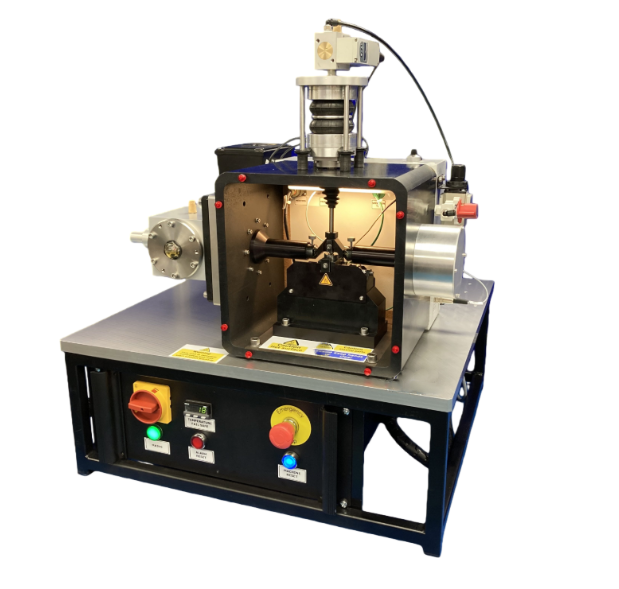


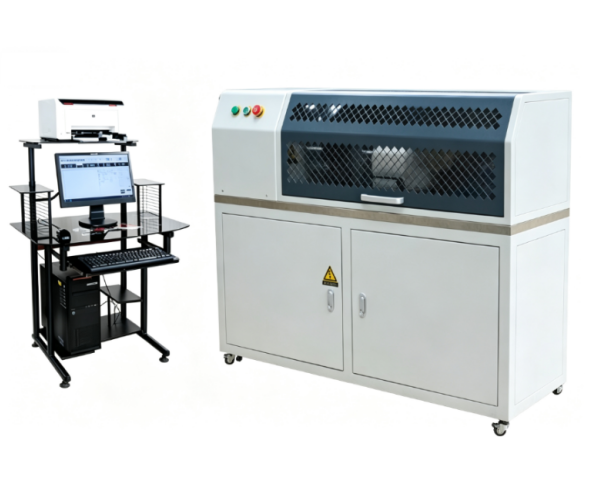
The Reciprocating Tribometer is a value-engineered tribological testing instrument designed for lubricated ball-on-flat experiments. You can perform high-frequency linear oscillation tests to evaluate friction, wear, and extreme pressure (EP) properties of lubricating greases, oils, and solid bonded films. The instrument combines a servo-pneumatic loading system, Scotch Yoke reciprocating mechanism, and touch-screen PC control for precise management of load, stroke, frequency, and temperature. You can collect real-time friction data via a piezoelectric transducer and export all test results for analysis.
Application
Evaluating lubricating grease friction and wear performance under high Hertzian contact.
Measuring extreme pressure (EP) properties of lubricating oils and solid bonded films.
Assessing fretting wear resistance of greases and lubricated components.
Determining scuffing limits and friction coefficients of mechanical transmission fluids.
Lubricated ball-on-flat and cylinder-on-flat contact tests for research and industrial labs.
Friction and wear testing of automotive transmission, hydraulic, and industrial lubricants.
Material screening and quality control in R&D or laboratory settings.
Standards
ASTM D5706 – EP properties of lubricating greases using high-frequency linear oscillation.
ASTM D5707 – Friction and wear of lubricating greases using high-frequency linear oscillation.
ASTM D6425 – Friction and wear of extreme pressure (EP) lubricating oils using high-frequency linear oscillation.
ASTM D7217 – EP properties of solid bonded films using high-frequency linear oscillation.
ASTM D7421 – EP properties of lubricating oils using high-frequency linear oscillation.
ASTM D7594 – Fretting wear resistance of lubricating greases under high Hertzian pressures.
ASTM D8227 – Coefficient of friction of synchronizers lubricated by mechanical transmission fluids (MTF).
ASTM D8503 – Scuffing temperature limit of lubricating oils using high-frequency linear oscillation.
Parameters
| Parameter | Specification |
|---|---|
| Load Type | Servo-controlled pneumatic bellows |
| Load Measurement | Strain gauge force transducer |
| Friction Force Measurement | Piezo transducer |
| Load Range | 25–1,200 N |
| Amplitude (Stroke) | 0.15 (0.30) mm, 0.5 (1.0) mm, 1.0 (2.0) mm, 1.5 (3 mm), 2.0 (4 mm) |
| Maximum Frequency | 50 Hz |
| Temperature Range | Ambient to 250°C |
| Temperature Sensor | K-type thermocouple |
| Test Samples | 10 mm diameter ball, 10 mm diameter cylinder |
| Control & Data Acquisition | Touch-screen PC & interface |
| Data Export | USB stick |
| Automatically Controlled | Frequency, Load, Temperature, Test Duration |
| Manually Controlled | Amplitude (Stroke) |
| Measured Parameters | Frequency, Load, Friction, Temperature, Test Duration, Friction Coefficient |
Features
(1) Touch-screen PC control for automatic sequence management and real-time data logging.
(2) Servo-pneumatic load system with strain gauge feedback ensures precise, repeatable loads.
(3) Scotch Yoke mechanism provides stable sinusoidal reciprocating motion.
(4) Fixed stroke lengths selectable via interchangeable cams for consistent test conditions.
(5) Piezoelectric transducer enables high-accuracy friction force measurement.
(6) Compatible with ball-on-flat and cylinder-on-flat test samples.
(7) Supports high-frequency testing up to 50 Hz for accelerated wear studies.
(8) Data export via USB allows easy post-test analysis and reporting.
Test Procedures
(1) Connect electricity and dry, clean air (4 cfm at 8 bar / 120 psi).
(2) Install the appropriate ball or cylinder sample.
(3) Set stroke amplitude manually via cam selection.
(4) Configure load, frequency, temperature, and test duration through touch-screen PC.
(5) Start the test, monitor friction, load, and temperature in real-time.
(6) After completion, export data to USB and evaluate friction coefficient, wear, and other test results.
(7) For high-temperature tests, ensure thermocouples and heating elements are operational.
(8) Regularly inspect samples and transducers for accuracy and repeatability.
Maintenance Information
(1) Ensure power and air supply meet specifications before operation.
(2) Clean test samples and holders after each test to prevent contamination.
(3) Verify the function of the load control system and sensors periodically.
(4) Calibrate piezo transducers and thermocouples according to schedule.
(5) Inspect mechanical components of Scotch Yoke and cams for wear.
(6) Store consumables in a dry environment to maintain integrity.
FAQ
(1) What materials can be tested using a reciprocating tribometer?
The instrument is mainly used for testing lubricating greases, oils, solid bonded films, and lubricated material contact pairs. It is widely applied in automotive lubrication, industrial equipment, and tribology research for evaluating friction and wear behavior.
(2) What is the purpose of high-frequency linear oscillation testing?
High-frequency reciprocating testing simulates repeated small-amplitude sliding conditions found in many mechanical systems. It helps evaluate friction coefficient, wear resistance, and extreme pressure performance under controlled laboratory conditions.
(3) Which parameters can be controlled during testing?
The system automatically controls frequency, load, temperature, and test duration, while stroke amplitude is manually adjusted. This allows researchers to reproduce different operating conditions and compare lubrication performance accurately.
(4) Can this instrument test lubricants used in automotive applications?
Yes, the tester is suitable for evaluating automotive transmission fluids, hydraulic oils, and other lubricants. It can analyze friction behavior, wear resistance, and scuffing performance according to ASTM-related testing methods.
(5) How can I select the right reciprocating tribometer for my laboratory?
Selection should consider load range, testing frequency, temperature requirements, sample type, and applicable standards. QINSUN instruments are calibrated and tested before shipment to ensure data accuracy. Please contact QINSUN engineers for professional guidance.
Leave Message Get Price