Tobacco Air Permeability Tester
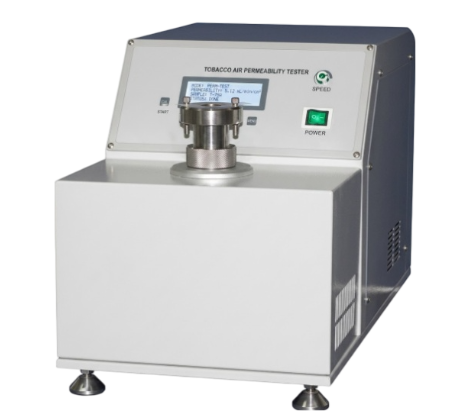


The Tobacco Air Permeability Tester is a precision instrument designed to evaluate the air permeability of tobacco, cut tobacco, and related tobacco materials using the airflow measurement method. By applying a controlled air pressure difference across a tobacco sample, the instrument measures airflow resistance to determine permeability characteristics, which are closely related to tobacco structure, draw resistance, and smoking performance. It adopts high-precision electronic flow and pressure sensors to provide fast, accurate, and repeatable test results for tobacco manufacturers, research laboratories, and quality control departments.
Application
(1) Cigarette Tobacco Testing:Used to measure the air permeability of cigarette tobacco and evaluate the influence of tobacco structure on draw resistance.
(2) Cut Tobacco Quality Control:Applicable for testing cut tobacco permeability to monitor consistency during production processes.
(3) Tobacco Product Development:Helps researchers analyze the relationship between tobacco density, structure, and airflow characteristics during product optimization.
(4) Raw Material Evaluation:Used for comparing permeability differences of different tobacco batches, varieties, or processing conditions.
(5) Production Process Monitoring:Supports quality inspection in cigarette manufacturing plants to maintain stable product performance.
(6) Research Institutions and Laboratories:Provides accurate permeability data for tobacco material studies and formulation research.
Standards
(1) ISO 2965 — Materials Used as Cigarette Papers, Filter Plug Wrap and Filter Joining Paper, Including Materials Having an Oriented Permeability — Determination of Air Permeability
(2) CORESTA Recommended Methods — Tobacco and Cigarette Physical Property Testing Methods
(3) ASTM D6112 — Standard Test Method for Dynamic Mechanical Properties of Packaging Materials (related airflow measurement principles)
(4) Relevant tobacco industry standards for tobacco permeability and draw resistance evaluation
Note: The applicable testing standard depends on the tobacco product type and customer quality control requirements.
Parameters
| Parameter | Specification |
|---|---|
| Testing Method | Airflow method |
| Measuring Range | 10 ml/s–60 ml/s |
| Pressure Range | 10 Pa–2500 Pa |
| Measuring Accuracy | <2% |
| Average Test Time | Approx. 15 seconds |
| Sensor Type | High-precision electronic flow sensor and pressure sensor |
| Data Communication | USB port connection |
| Report Output | Test data analysis and EXCEL report export |
| Power Supply | AC 100–240 V, 50/60 Hz |
| Dimensions | L520 × W280 × H300 mm |
| Weight | 10 kg |
| Warranty | 24 months |
Features
(1) Uses high-precision flow and pressure sensors for accurate permeability measurement.
(2) One-button operation simplifies the testing process and improves efficiency.
(3) Fast testing with an average measurement time of approximately 15 seconds.
(4) USB communication supports data analysis and report export.
(5) Digital measurement system improves test repeatability.
(6) Suitable for tobacco manufacturers, laboratories, and research institutions.
(7) Compact design saves laboratory space and allows convenient operation.
(8) Provides reliable data for tobacco quality control and product development.
FAQ
(1) What is the purpose of testing tobacco air permeability?
Tobacco air permeability testing helps evaluate airflow characteristics related to tobacco structure and draw resistance. It provides important data for controlling cigarette quality, optimizing formulations, and maintaining production consistency.
(2) What tobacco materials can be tested with this instrument?
The tester is mainly suitable for tobacco, cut tobacco, and related tobacco materials. It can compare permeability differences caused by material properties, processing conditions, and production batches.
(3) How long does one tobacco permeability test take?
The average testing time is approximately 15 seconds. The one-button operation design allows operators to complete measurements efficiently while reducing manual operation errors during routine quality inspection.
(4) What factors affect tobacco air permeability results?
Results may be influenced by tobacco density, moisture content, particle size, filling structure, and sample preparation conditions. Proper sample handling and regular calibration help maintain reliable test accuracy.
(5) How can I choose the right tobacco air permeability tester?
Selection should consider measuring range, pressure requirements, testing standards, data management needs, and production application. QINSUN instruments are calibrated and tested before shipment to ensure accurate measurement results. For customized solutions and customer application cases, please contact engineers for professional guidance.
Leave Message Get Price