Shoe Heat Insulation Sand Bath Tester
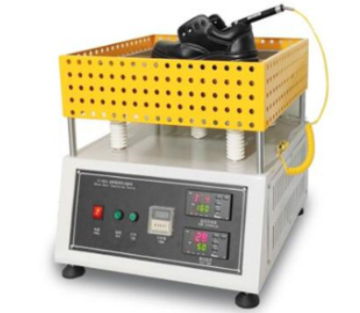


Shoe Heat Insulation Sand Bath Tester is a professional testing instrument designed to evaluate the thermal insulation performance of footwear under high-temperature conditions. The instrument simulates extreme heat environments by heating a sand bath to a specified temperature and measuring the temperature change on the insole surface after the footwear sample is exposed for a certain period. It is mainly used to assess the heat insulation capability of shoe soles and upper structures, providing reliable test data for footwear safety evaluation, quality control, and product development.
Application
(1) Footwear Quality Control: Used by shoe manufacturers to verify the thermal insulation performance of different production batches and ensure products meet design requirements.
(2) Protective Footwear Testing: Suitable for evaluating heat resistance performance of industrial safety shoes, protective shoes, and footwear used in high-temperature working environments.
(3) Product Development and Material Research: Helps manufacturers compare the influence of different sole materials, insulation layers, structures, and designs on thermal protection performance.
(4) Laboratory Testing and Certification: Used in footwear testing laboratories and third-party inspection organizations for compliance evaluation.
(5) Performance Comparison Testing: Provides test data for comparing thermal insulation performance between different footwear models, materials, and suppliers.
Standards
(1) EN ISO 20344 — Personal Protective Equipment — Test Methods for Footwear
(2) EN ISO 20345 — Personal Protective Equipment — Safety Footwear
(3) EN 12568 — Foot and Leg Protectors — Requirements and Test Methods for Toecaps and Penetration Resistant Inserts
(4) GB/T 20991-2007 — Personal Protective Equipment — Test Methods for Footwear
(5) ANSI Footwear Testing Standards — Applicable requirements for protective footwear performance evaluation
(6) JIS Footwear Standards — Japanese Industrial Standards related to footwear testing
(7) CSA Standards — Applicable Canadian protective footwear requirements
(8) LD50-1994 — Labor Protection Equipment Standards
Technical Parameters:
| Parameter | Specification |
|---|---|
| Sand Bath Size | (40 ± 2) cm × (40 ± 2) cm, height ≥5 cm |
| Sand Volume | 5000 ± 250 cm³ |
| Sand Particle Size | 0.3–1.0 mm |
| Hot Plate Temperature Range | Room temperature to 150 ± 5℃ or 250 ± 5℃ |
| Heating Power Consumption | 2500 ± 250 W |
| Dimensions (W×D×H) | 55 × 55 × 33 cm |
| Weight | 35 kg |
| Power Supply | 1Φ, 220V (or customized) |
Features
(1) Simulates high-temperature sand environments to evaluate footwear thermal insulation performance.
(2) Provides stable heating control for repeatable test conditions.
(3) Suitable for evaluating different footwear structures and insulation materials.
(4) Supports high-temperature testing requirements up to 250℃.
(5) Large sand bath area accommodates different footwear samples.
(6) Accurate sand particle size and volume control improve test consistency.
(7) Compact structure suitable for footwear laboratories and quality inspection departments.
FAQ
(1) What performance does the Shoe Heat Insulation Sand Bath Tester evaluate?
The instrument evaluates the thermal insulation capability of footwear by simulating high-temperature environments and measuring heat transfer to the insole area. It helps determine whether shoe structures and materials can provide sufficient thermal protection.
(2) Which footwear products can be tested with this instrument?
The tester is suitable for safety shoes, protective footwear, industrial work shoes, and other footwear products requiring heat insulation evaluation. It can also be used during material development to compare different sole and insulation structures.
(3) Why is sand bath testing important for footwear development?
Sand bath testing provides a controlled high-temperature environment to evaluate how materials respond to heat exposure. Manufacturers can use the results to optimize sole materials, insulation layers, and product designs before mass production.
(4) What temperature range can the tester simulate?
The hot plate temperature can reach room temperature to 150℃ ±5℃ or 250℃ ±5℃ depending on configuration. This allows laboratories to perform thermal insulation evaluations under different high-temperature application conditions.
(5) How to select the suitable footwear heat insulation tester?
Selection should consider footwear type, required testing standards, temperature range, and laboratory requirements. QINSUN instruments are calibrated and tested before shipment to ensure accurate data. For customized solutions and application cases, please contact QINSUN engineers for professional guidance.
Leave Message Get Price