Plate Thermal Conductivity Tester
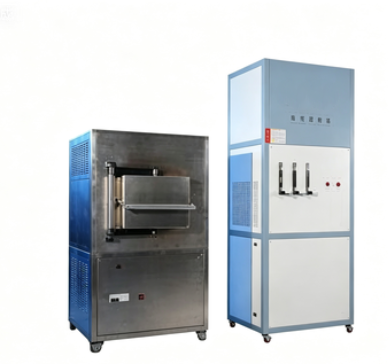


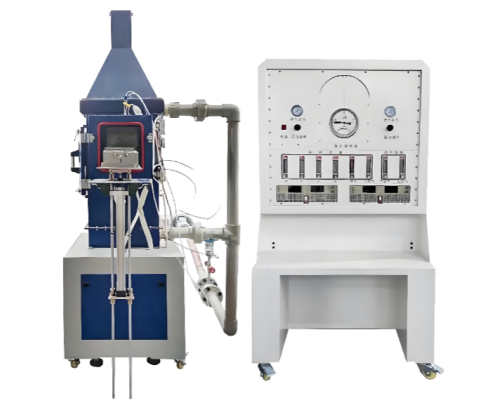
The Plate Thermal Conductivity Tester is designed to measure the thermal conductivity of various insulating and refractory materials under controlled temperature conditions. It is suitable for testing materials such as ceramic fiber, insulation boards, textiles, felt, bricks, and refractory products.
Using the water flow plate method, the instrument provides accurate thermal conductivity values across a wide temperature range, making it ideal for material research, quality control, and industrial applications involving heat insulation performance.
Application
(1)Refractory Materials Testing
Evaluation of thermal conductivity in high-temperature insulation materials and refractory bricks.
(2)Ceramic Fiber Products
Testing thermal performance of ceramic fiber blankets, boards, and insulation modules.
(3)Textile and Felt Materials
Measurement of thermal insulation properties of industrial textiles and felt materials.
(4)Building and Insulation Materials
Assessment of insulation boards and thermal barrier materials.
(5)Material Research and Development
Used in laboratories to analyze heat transfer behavior and optimize material formulations.
Standards
GB / T 17911-2006 "Test method for refractory ceramic fiber products", applicable YB / T 4130-2005 "Test method for thermal conductivity of refractory materials (water flow plate method)" GB / T 17911-2006.
parameters
1. Thermal conductivity meter Dimensions: 780mm * 780mm * 1360mm
2. Heating furnace test temperature: 200 ℃ -1250 ℃
3. Temperature accuracy: ± 1 ℃
4. Sample size: 230mm × 230mm * (40-100) mm
5. The number of specimens: 1-4 block
6. Power supply voltage: 380V, 50HZ
7. Air switch: 380V, 16A
8. Measuring range: Range (0.03-2.00) W / (m·K)
9. Drying and heat treatment: samples and pads placed at 110 ℃ ± 5 ℃ dry to constant weight, or according to the requirements of the process of processing products
Flowmeter parameters
1. Motherboard flowmeter: (2.5-25) L / H 20 ℃
2. Hood flowmeter: (2.5-25) L / H 20 ℃
3. Water supply flowmeter: (10-100) L / H 20 ℃
Features:
1. Online double calibration: unique technology, while calibrating the temperature, calibration system error, accurate, fast and convenient.
2. Measuring range: Range (0.03-2.00) W / (m·K).
3. Measurement of many types: fire insulation, ceramic fiber, carpets, textiles, plates, bricks.
4. Control the use of Japanese PLC and temperature expansion module and other integrated design, can effectively reduce the interference and improve equipment stability.
5. The output adopts the new non-contact switching device, with high reliability, long life, low noise, fast switching speed, anti-interference ability, improve equipment life and safety.
6. Control method for the PID control, through the software self-tuning PID parameters to adjust to ensure the tracking accuracy.
7. Independent research and development of industrial control software, easy to operate, easy to maintain. Software using Visual Basic6.0 development, real-time data storage, power can continue after the interface intuitive, easy to operate, remote maintenance.
8. Using RS-232C standard serial communication, can be synchronized to collect experimental data. Store data directly in Excel form, easy to handle.
9. Remote online services: Our customer service personnel through the network for maintenance and repair; to help solve difficult problems; regular software upgrades.
FAQ
(1)What materials can be tested with this equipment?
The tester is suitable for refractory insulation materials, ceramic fibers, textiles, insulation boards, bricks, and other materials requiring thermal conductivity evaluation.
(2)What is the testing principle used?
The instrument uses the water flow plate method, which determines thermal conductivity by measuring heat transfer through the sample under controlled temperature conditions.
(3)Why is high-temperature testing important?
Many insulation and refractory materials operate in high-temperature environments. Testing at elevated temperatures ensures accurate evaluation of real working conditions.
(4)How is test accuracy ensured?
Accuracy is achieved through double calibration, precise temperature control, stable flow measurement, and PID-controlled heating.
(5)Who uses this equipment?
The system is used by material manufacturers, research institutes, construction material laboratories, and industrial quality control departments for thermal performance evaluation and product development.
Leave Message Get Price