Large Cone Calorimeter ISO 5660
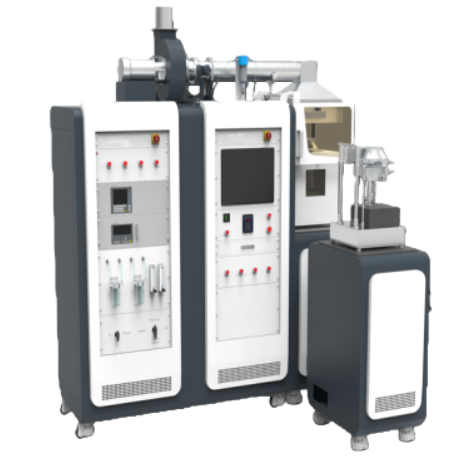


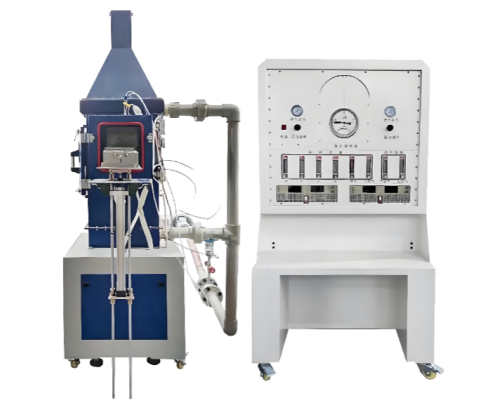
The Large Cone Calorimeter with Variable Atmosphere is designed to measure the heat release rate of materials based on the oxygen consumption principle. You can accurately determine material combustibility, ignition time, mass loss rate, and derived data such as effective heat of combustion and specific extinction area. During testing, samples are placed on a loading unit, heated, and ignited with an electric spark. Combustion gases are collected through exhaust and adsorption ducts, and parameters such as gas concentration, pressure, temperature, and smoke density are automatically recorded. This instrument provides a safe, fast, and reliable method for material development, fire research, and quality control.
Application
You can apply this apparatus in the following scenarios:
Material development: Evaluate thermal and combustion properties of building, decorative, or industrial materials.
Fire safety research: Study heat release, smoke generation, and flame propagation under controlled atmospheres.
Quality control: Monitor material performance to ensure compliance with fire safety standards.
Automotive and transportation: Assess heat release and smoke production of interior materials under varying atmospheric conditions.
Compatible test components: Loading unit, electric spark ignition system, exhaust and adsorption ducts, optical smoke measurement system, mass balance, data acquisition and processing software.
Standards
This apparatus conforms to the following international and national standards:
GB/T 16172‑2007 — Determination of heat release rate and total heat release of building materials and products (Cone Calorimeter Method)
ISO 5660‑1 — Heat release, smoke production, and mass loss measurement for building materials (Cone Calorimeter Method, Part 1)
ISO 5660‑2 — Heat release, smoke production, and mass loss measurement (Part 2: Flame spread testing)
ISO 5660‑4 — Heat release and smoke generation test for automotive interior materials
ISO 5660‑5 — Heat release, smoke production, and mass loss measurement: Additional assessment requirements
ASTM E1354 — Cone calorimeter method for heat release rate and visible smoke release
ASTM E2965 — Guidelines for assessing material combustibility using oxygen consumption
Parameters
| Parameter | Specification |
|---|---|
| Dimensions | 2135 × 915 × 2810 mm |
| Weight | 650 kg |
| Mass Balance Range | 6000 g, resolution 0.01 g |
| Gas Analysis | German Siemens analyzer, high precision |
| Exhaust System | Condensation-type smoke treatment with triple filtration |
| Material Handling | Sample loading unit with automated placement |
| Software | Integrated data acquisition and analysis system |
| Operating Gas | Compressed air |
| Calibration Gases | Methane, N2. CO2/CO mixed gas |
| Power Requirement | 220V / 380V, 50 Amps |
| Operating Temperature | 10–35°C |
Features
Integrated computer and acquisition system: Streamlines data collection and analysis.
Durable stainless steel housing: Ensures long-term stability and corrosion resistance.
Triple filtration system: Effectively cleans exhaust gases and protects sensors.
High-resolution mass balance: Measures sample mass loss accurately with 0.01 g resolution.
High-precision gas analysis: Siemens analyzer provides reliable measurement of combustion gases.
Condensation-type smoke treatment: Efficiently collects and condenses combustion gases.
User-friendly operation: No need to manually remove or insert optical filters during testing.
Robust main filter: Stainless steel housing ensures durability and easy maintenance.
Test Procedures
Install the sample on the loading unit and ensure proper positioning.
Connect compressed air and calibration gas supplies.
Set the cone heater to the desired heat flux and ignite the sample using the electric spark system.
Measure mass loss, gas concentration, temperature, and smoke density during combustion.
Data is automatically recorded and processed to calculate heat release rate, effective heat of combustion, and derived parameters.
After testing, safely remove the sample and perform routine cleaning of the exhaust and measurement systems.
Maintenance Information
Clean the cone heater, exhaust ducts, and filters regularly to maintain measurement accuracy.
Calibrate the mass balance, gas analyzers, and optical smoke measurement system periodically.
Inspect the sample loading unit and ignition system before each test.
Ensure the exhaust system and filtration components are unobstructed.
Maintain ambient temperature between 10–35°C and verify gas supply pressures before operation.
FAQ
(1) What parameters can the Large Cone Calorimeter measure?
The Large Cone Calorimeter measures important fire performance parameters including heat release rate, total heat release, ignition time, mass loss rate, effective heat of combustion, and specific extinction area. Based on the oxygen consumption principle described in ISO 5660-1 and ASTM E1354, it provides quantitative data for evaluating the combustion characteristics of building materials, polymers, composites, and transportation materials.
(2) What materials can be tested using the Large Cone Calorimeter?
The Large Cone Calorimeter is suitable for testing various combustible materials, including building products, insulation materials, plastics, composite materials, coatings, and automotive interior components. It helps researchers and manufacturers evaluate ignition behavior, heat release performance, and smoke generation characteristics during material development and fire safety verification.
(3) How does the oxygen consumption principle work in the Large Cone Calorimeter?
The Large Cone Calorimeter calculates heat release based on the relationship between oxygen consumption and combustion energy release. During testing, combustion gases are collected through the exhaust system, and oxygen concentration changes are measured by the gas analyzer. This method provides accurate heat release data according to ISO 5660-1 and ASTM E1354 requirements.
(4) Why is smoke measurement important in cone calorimeter testing?
Smoke generation is a critical factor in fire safety evaluation because it affects visibility and evacuation conditions during a fire. The Large Cone Calorimeter integrates an optical smoke measurement system to evaluate smoke production and specific extinction area, providing additional information beyond heat release measurement for comprehensive fire performance analysis.
(5) What should laboratories consider when selecting a Large Cone Calorimeter?
Laboratories should consider standard compliance, measurement accuracy, gas analysis capability, smoke measurement functions, data acquisition systems, and equipment safety features. The Large Cone Calorimeter complies with major standards including GB/T 16172, ISO 5660-1, and ASTM E1354, making it suitable for professional fire testing laboratories and industrial material evaluation.
Leave Message Get Price