Safety Helmets Against Molten Metal Splashing Tester
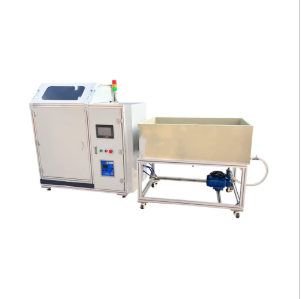


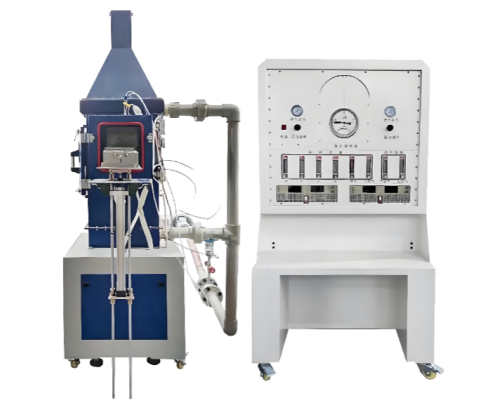
The Safety Helmets Against Molten Metal Splashing Tester is designed to evaluate the resistance of protective helmets to molten metal splashes under controlled laboratory conditions. The system uses a controlled molten-metal pouring process to expose the helmet to a specified quantity and temperature of molten metal, helping assess whether the helmet can withstand the thermal and mechanical effects of molten-metal splashing.
The supplied configuration includes a high-temperature furnace, controlled pouring mechanism, test chamber, temperature-control system, and safety protection system. It is intended for safety helmet development, quality control, and conformity testing.
Application
The tester is suitable for:
(1) Industrial Safety Helmets
Evaluating helmets used in metalworking, foundries, welding-related environments, and other workplaces where molten metal splash may occur.
(2) Helmet Material Development
Comparing shell materials and protective structures for resistance to molten-metal exposure.
(3) Helmet Quality Control
Supporting production inspection and verification of helmet performance.
(4) Protective Equipment Research
Studying the effects of molten-metal temperature, pouring conditions, and helmet construction on protective performance.
(5) Compliance Testing
Providing controlled molten-metal exposure conditions for laboratory evaluation according to the applicable test standard.
Standards
(1) GB 2811-2019 — Head Protection — Safety Requirements and Test Methods
(2) ISO 13832-1 — Protective clothing — Performance requirements for protective clothing against molten metal splashes
(3) EN 348 — Protective clothing — Test method for determination of behaviour of materials upon impact of small splashes of molten metal
The supplied source lists ISO 13832-1 and EN 348 in relation to molten-metal splash testing. The exact applicability of each standard should be confirmed against the specific helmet product and certification program before testing.
Parameters
| Parameter | Specification |
|---|---|
| Pouring Height | 225 ± 5 mm |
| Pouring Height Adjustment | 100 mm adjustable range |
| Furnace Capacity | 150 ± 10 g iron |
| Iron Composition | ≥93% Fe |
| Maximum Furnace Temperature | 1,800°C |
| Standard Test Temperature | 1,400 ± 20°C |
| Standard Heating Time | <30 min to 1,400°C |
| Cooling System | Water cooling for controls; air cooling for test chamber |
| Furnace Power | 15 kW |
| Total Power Supply | 380 V / 50 Hz, 25 kW, 3-phase |
| Test Chamber Lining | 1,200°C-rated ceramic fiber insulation |
| Observation Window | Borosilicate glass |
| Footprint | 1,250 × 750 × 1,350 mm (L × W × H) |
| Net Weight | Approx. 350 kg |
| Weight with Accessories | Approx. 400 kg |
FAQ
(1) What does the molten metal splashing test evaluate?
The test evaluates the ability of a safety helmet to withstand exposure to molten metal under specified conditions. It focuses on the helmet's response to the thermal and physical effects produced when molten metal contacts the protective structure.
(2) Why is the molten-metal temperature important?
Temperature directly affects the thermal energy delivered to the helmet during exposure. The supplied configuration specifies a standard test temperature of 1,400 ± 20°C, while the furnace can reach up to 1,800°C, allowing controlled high-temperature operation.
(3) Can the pouring height be adjusted?
Yes. The standard pouring height is 225 ± 5 mm, with a stated 100 mm adjustment range. The required position should be configured according to the applicable test procedure rather than adjusted arbitrarily.
(4) What should be considered when selecting this tester?
The main considerations are the applicable helmet standard, molten-metal type and quantity, required pouring height, test temperature, sample dimensions, safety enclosure, and laboratory utilities. These requirements should be confirmed before equipment configuration and purchase.
(5) Can QINSUN help confirm the configuration before purchase?
Yes. QINSUN engineers can review your helmet type, target standard, molten-metal requirements, laboratory conditions, and testing procedure before recommending the appropriate configuration.
Leave Message Get Price