Martindale Abrasion And Pilling Tester
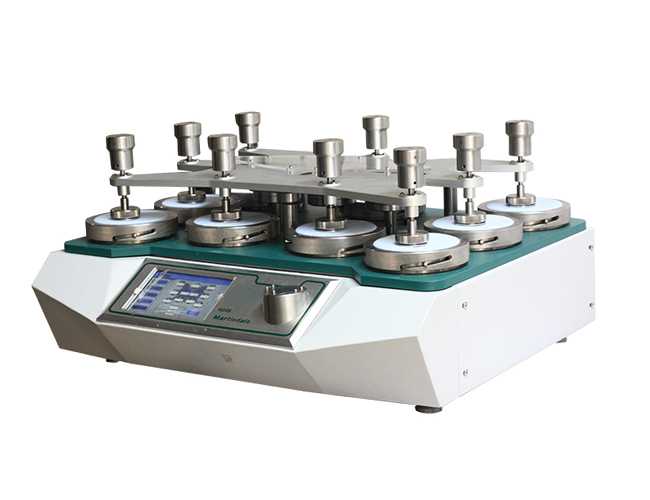


The Martindale Abrasion And Pilling Tester is professionally designed to determine the abrasion and pilling resistance of all kinds of textile structures. Samples are rubbed against known abradents at low pressures and in continuously changing directions and the amount of abrasion or pilling is compared against standard parameters.
Martindale Abrasion & Pilling Tester. To determine the abrasion and pilling resistance of all kinds of textile structures. Samples are rubbed against known abrasives at low pressures and in continuously changing directions. The amount of abrasion or pilling is compared against standard parameters.ovided with Touch Screen Controller and unique programming device which includes preprogammable batch and totaliser counters, individual station counters, 4 selectable test speeds with liquid crystal display.
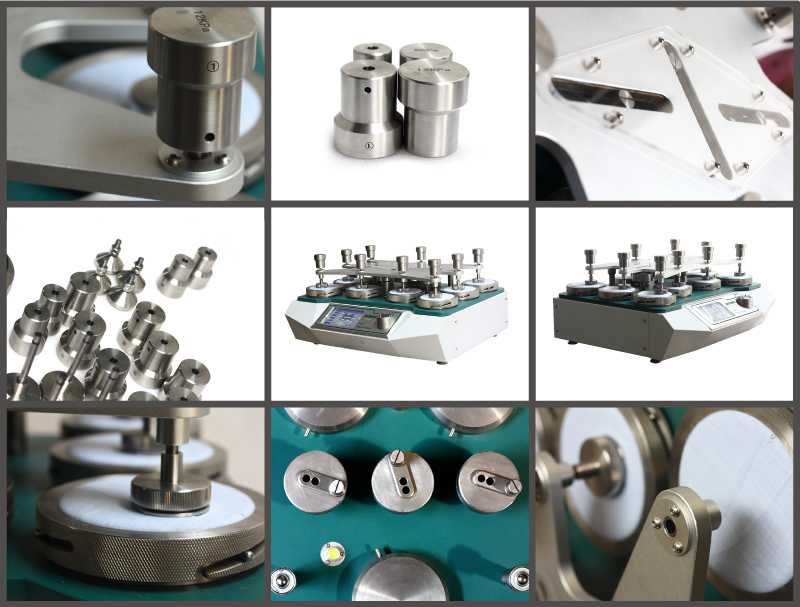
The unique design of our Martindale abrasion tester allows removal of individual sample holders for examination without lifting the top motion plate. It provides individual counters and parking function, interval time settable and a large touch-screen display. Standard sample holders and 9 and 12kpa Weights are included.
The Martindale abrasion tester is available with 4, 6, 8 or 9 test positions.
Application
(1) Fabric abrasion resistance testing
Used to determine the wear resistance of woven fabrics, knitted fabrics, coated fabrics, and other textile structures.
(2) Pilling resistance evaluation
Used to assess the tendency of fabrics to form pills after repeated rubbing.
(3) Garment quality control
Applied for durability inspection of clothing fabrics, uniforms, and fashion textiles.
(4) Home textile testing
Suitable for evaluating upholstery fabrics, curtains, bedding materials, and decorative textiles.
(5) Wool and blended fabric evaluation
Used for wool products and blended materials requiring pilling performance assessment.
(6) Research and development
Supports comparison of fiber types, fabric constructions, finishing processes, and surface treatments.
Testing Standards
ASTM D4970, ISO 12945.2, GB/T 4802.2/13775/21196.1/21196.2, ASTM D4966, ISO 12947, FZ/T 20020, BS 3424-24/5690, ISO 12947.1/12947.2, M&S P17/P19/P19C, NEXT 18/18a/18b, ISO 5470-2, IWTO-40, JIS L1096 8.17.5 Method E, Woolmark TM 112/196, BS EN 388/530/13770, ISO 20344
Technical Parameters
1.Test positions: 9;
2.Count range: 0~999999;
3.Maximum stroke: horizontal 60.5±0.5mm, longitudinal 24±0.5mm;
4.Weight of pressurized materials:
a.Clamp holder assembly: 200±1g
b.Loading pieces for smaller piece: 395±2g
c.Loading pieces for larger piece: 594±2g
d.Stainless steel piece: 260±1g
5.Additional loading weight valid abradent diameter:
Type A 200g(1.96N) Pressure(9KPa) ¢28.8-0.084mm
Type B 155g(1.52N) Pressure (12KPa) ¢90-0.10mm
6.The relative speed with Clamp holder and Abrading table: 20-70r/min(Adjustable);
7.Weight of ample loading hammer: 2385±10g.
Configurations and Consumables
1.Specimen holder assembly of 9 sets;
2.9kPa, 12kPa additional loading weight , each of 9;
3.¢38mm, ¢140mm Abradent Fabric/Backing Felt cutter of 1 set;
4.¢38mm, ¢140mm test specimen cutting mat of 1 set;
5.Pilling Test Suite of 1 set;
6.SM-50 Photographs for pilling test of 1 set;
7.EMPA Photographic Standards for Pilling Test of 1 set, and SM-25 Standard Abradent Fabric of 1.6m×5m;
8.Standard Backing Foam. Width of 1.5m, Length of 0.5m. Pack of 4;
9.Standard Backing Felt Piece of 1;
10.¢90mm Standard Backing Felt Discs(Pack of 20);
11.¢38mm, ¢140mm spare blades of specimen cutter, 50 each;
12.Other necessary accessories recommended by manufacturer.
Specifications
Drive system is PLC, programmable control with large touch-screen
①Abrasion test
Max stroke of movement 5+/-0.5mm
Weight of holder and spindle 200+/-1g
②Pilling test
Max stroke of movement 24+/-0.5mm
Weight of holder and spindle 155+/-1g
Features
(1) Realistic Human Heat and Sweat Simulation
Uses breathable fabric skin and water circulation technology to simulate human perspiration and heat regulation behavior.
(2) Dynamic Clothing Performance Evaluation
Motorized limbs enable walking motion simulation, allowing evaluation of clothing performance under realistic activity conditions.
(3) High Measurement Repeatability
The system provides stable thermal performance measurement, with clothing thermal resistance and moisture resistance tests showing good repeatability.
(4) Independent Body Zone Control
Multiple heating zones allow simulation of different human body temperature conditions and localized thermal performance analysis.
(5) Advanced Temperature Control Technology
Combines PID and fuzzy algorithms to improve temperature regulation accuracy during testing.
(6) Comprehensive Comfort Analysis
Professional software calculates thermal resistance, CLO value, and evaluates human thermal comfort under different environmental conditions.
(7) Flexible Configuration Design
Modular structure allows customization of sweat systems, fluid distribution systems, fabric skin materials, and environmental testing requirements.
(8) Safe and Reliable Operation
Integrated protection functions prevent leakage risks and automatically stop operation during abnormal temperature conditions.
Working principle:
Test piece of fabric is placed in the specimen clamp, and it will be rubbed against with abradant in a Lissajous figure. According to the requirement, once the test piece is broken, test piece should be taken down to calculate its abrasion resistance index, or evaluate its rating of pilling through the visual description.
FAQ
(1) What properties can be evaluated using a Martindale tester?
The instrument mainly evaluates fabric abrasion resistance and pilling tendency. It simulates repeated rubbing conditions to analyze surface wear, fuzz formation, and appearance changes according to specified testing methods.
(2) Which textile materials are suitable for Martindale testing?
It can be used for many textile structures, including woven fabrics, knitted fabrics, wool textiles, blended materials, upholstery fabrics, and garment fabrics. The specific test method depends on the material type and product requirements.
(3) How are abrasion results evaluated after testing?
Abrasion evaluation may be based on specimen damage, mass loss, appearance change, or the number of cycles required to reach a defined endpoint. The evaluation method should follow the selected standard.
(4) What factors affect fabric pilling test results?
Fiber characteristics, yarn structure, fabric construction, finishing treatment, and testing conditions can influence pilling performance. Standardized specimen preparation and correct abrasive selection are important for reliable comparison.
(5) How should a Martindale tester be selected for a laboratory?
Selection should consider required test standards, number of test stations, loading conditions, automation level, and application requirements. For detailed configuration recommendations, please contact QINSUN engineers for professional guidance.
Product display
Leave Message Get Price