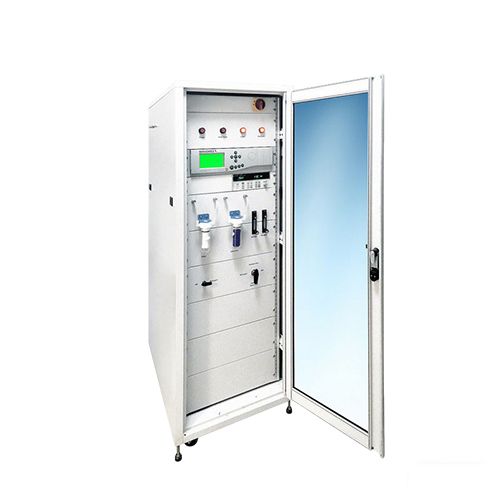
Filter Test System for gas adsorption/desorption of air filters for passenger compartments
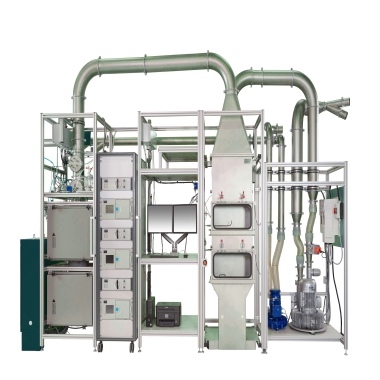


The Filter Test System for gas adsorption/desorption of air filters for passenger compartments is designed to quantify the adsorption capacity and desorption behavior of filter elements and media. The system supports accurate testing in compliance with DIN 71460-2 and ISO 11155-2, allowing dynamic gas adsorption measurements under controlled conditions. Stainless steel construction, precise dosing units, and integrated mass flow controllers ensure reliable, reproducible, and standard-compliant test results.
Application
(1) Quantification of adsorption capacity of passenger compartment air filters.
(2) Measurement of desorption behavior and gas breakthrough of cabin air filters.
(3) R&D of new filter media with optimized gas adsorption performance.
(4) Quality control and verification of filter production according to DIN 71460-2 / ISO 11155-2.
(5) Comparative testing of filter elements from different manufacturers.
(6) Testing of integrated cabin filter assemblies, including panel, pleated, and compact filters.
Standards
(1) ISO 11155-2 — Air filters for passenger compartments — Gas adsorption and desorption testing.
(2) DIN 71460-2 — Cabin air filter gas adsorption tests.
(3) ISO 10121-2 — Automotive air filter gas adsorption testing.
(4) ISO 10121-1 — Automotive air filter particle efficiency testing.
(5) DIN 71460-1 — Cabin air filter particle separation tests.
(6) ISO/TS 11155-1 — Particle filtration testing of cabin air filters.
Features
(1) Standard-compliant testing of both filter elements and media.
(2) Operator guidance through fully automated test routines.
(3) Modular system design with versatile instrumentation.
(4) Flexible mounting for different filter media sizes and elements.
(5) Visual observation window for real-time monitoring during testing.
(6) Precise dosing of gaseous and liquid components using mass flow controllers and droplet spray atomization.
(7) Stable gas concentration maintained by integrated exhaust system bypass.
Parameters
| Parameter | Unit | Value |
|---|---|---|
| Test flow rate | m³/h | 70 – 700 |
| Measuring range, differential pressure | Pa | 0 – 1000 |
| Test gases | – | n-Butane 80 ppm (C₄H₁₀), Toluene 80 ppm (C₆H₅CH₃), Sulfur dioxide 30 ppm (SO₂), Ammonia 30 ppm (NH₃), Nitrogen (purging) |
| Power supply | – | 3 × 230 VAC, 16 A |
| Test specimen dimensions | mm | max. 300 × 600 |
| Gas analysers | – | Hydrocarbons: FID; Sulfur oxides: NDIR; Nitrogen oxides: CLD |
| Sensors (others) | – | Temperature, relative humidity, absolute pressure |
| System dimensions (W × H × D) | mm | 1800 × 2500 × 1100 |
Test Procedures
(1) Mount the filter element or media sample in the adapter within the test section.
(2) Select the test gases according to the relevant standard or customer requirements.
(3) Set test parameters including flow rate and differential pressure.
(4) Start automated test sequence via control software.
(5) Introduce gaseous components using mass flow controllers; use droplet spray atomization for liquid components.
(6) Measure gas concentrations downstream of the filter with appropriate gas analyzers.
(7) Monitor differential pressure and adsorption/desorption curves continuously.
(8) Generate automated test reports for evaluation and record-keeping.
Maintenance Information
(1) Regular cleaning of test section and stainless steel ducts.
(2) Periodic calibration of gas analyzers, mass flow controllers, and sensors.
(3) Inspection of filter adapters and seals to ensure leak-free operation.
(4) Maintain exhaust system and dosing units to prevent clogging or drift.
(5) Update control software and verify automated test sequences before each test campaign.
FAQ
(1) What is this product?
– A test system for cabin air filters that measures gas adsorption capacity and desorption behavior.
(2) What is it used for?
– To evaluate the dynamic gas adsorption and desorption performance of filter media and elements in passenger compartments.
(3) What types of this product exist?
– Configurations for panel filters, pleated filters, and compact integrated filter assemblies.
(4) What industry problems does it solve?
– Ensures reliable cabin air filter performance, verifies compliance with DIN and ISO standards, and supports R&D and production testing.
(5) How is it operated?
– Mount the filter in the adapter, select the appropriate test gases, start the automated sequence, monitor adsorption/desorption behavior, and generate test reports.
Leave Message Get Price