Automobile Seat Frame Strength Test Bench
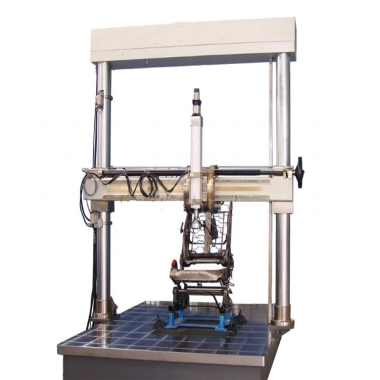


The Automobile Seat Frame Strength Test Bench is designed to evaluate the structural strength and durability of automotive seat frames, seat fixers, and headrests under various load conditions. It simulates real-world forces, including forward, backward, and torsional loads, to ensure seat components comply with international and national safety standards. The test bench is widely used by automotive OEMs, seat manufacturers, and testing laboratories for performance verification, quality control, and R&D purposes.
Application
The test bench is mainly used for mechanical performance evaluation of automotive seat components.
Typical applications include:
(1) Automotive OEM Testing
Used by vehicle manufacturers to verify seat structure strength and safety performance during vehicle development.
(2) Seat Manufacturer Quality Control
Helps suppliers inspect seat assemblies and confirm whether products meet required strength and durability requirements.
(3) Automotive Component Research and Development
Provides test data for optimizing seat frame structures, fixing systems, and adjustment mechanisms.
(4) Safety Performance Evaluation
Simulates different loading conditions to assess the ability of seat components to withstand external forces.
(5) Laboratory Compliance Testing
Used by professional testing organizations for standard-based verification of automotive seat assemblies.
Standards
GB 15083-2006 – Automotive seats, seat fixers, and headrest strength requirements and tests.
GB 13057-2003 – Strength of passenger car seats and vehicle fasteners.
QC/T 740-2005 – Passenger car seat assembly.
QC/T 633-200X – Bus seat requirements.
JT/T 460-2001 – Passenger car seat back angle adjuster technical requirements.
FMVSS 207 – Federal Motor Vehicle Safety Standard, strength requirements for seat backs and adjustment devices.
ECE R17 – ECE regulation on the strength of car seats and seat belt anchors.
Technical Parameters
| Parameter | Specification |
|---|---|
| Input Voltage | Three-phase AC 380±10%, Single-phase AC 220±10% |
| Force Sensor Accuracy | ±1% FS |
| Measuring Range | 0–2000 N |
| Test Frequency | 5–30 cycles/min (adjustable) |
| Floor Area | 3500 × 3500 × 2500 mm |
| Control Mode | Computer-controlled servo system |
| Data Acquisition | Real-time recording and automatic test report generation |
Features
High loading capacity to simulate extreme conditions, including high-magnitude static and dynamic loads.
Supports multiple loading methods such as horizontal forward, horizontal backward, and torsion to cover a variety of test scenarios.
Computer-controlled servo system ensures precise loading and measurement.
Real-time data acquisition and processing with automatic test report generation.
Configurable number of test cycles for durability and fatigue evaluation.
Durable mechanical structure designed for stable long-term operation.
Safety features including emergency stop, overload protection, and compliance with electrical safety standards.
Optional Accessories
Adjustable seat fixtures for different seat types
High-precision force sensors for extended measurement range
Data acquisition and analysis software
Protective covers and anti-vibration mounting base
Calibration kits for sensors and load cells
FAQ
(1) What tests can be performed with an Automobile Seat Frame Strength Test Bench?
We use this test bench to evaluate the structural strength and durability of automotive seat components, including seat frames, seat fixers, and headrests. The system can perform forward loading, backward loading, torsional testing, and repeated durability tests to assess whether seat assemblies meet required safety and performance requirements.
(2) Which automotive components can be tested with this equipment?
We design this system mainly for automotive seat-related components, including complete seat assemblies, seat frames, mounting structures, headrests, and adjustment mechanisms. It is commonly used by vehicle manufacturers, seat suppliers, and testing laboratories for product verification and quality inspection.
(3) How does the test bench ensure accurate strength testing results?
We use a computer-controlled servo loading system combined with force sensors and real-time data acquisition technology. The system controls loading conditions precisely, records test data automatically, and generates reports to help engineers analyze structural performance and verify test results.
(4) Why is automotive seat strength testing important?
We perform seat strength testing because seat structures are closely related to vehicle safety performance. Testing helps manufacturers identify structural weaknesses, verify compliance with safety standards, and improve seat design reliability before vehicles enter production.
(5) How can customers select the suitable Automobile Seat Frame Strength Test Bench?
We recommend that customers confirm the tested seat components, required standards, loading methods, force range, and laboratory space before purchasing. Our QINSUN engineers can provide detailed technical parameters and professional guidance to help customers select suitable testing equipment according to their application requirements.
Leave Message Get Price